What Is a Medical Specialist Network? A Patient’s Guide

A medical specialist network is defined as an organized group of credentialed healthcare professionals who deliver specialty care under coordinated clinical and administrative frameworks designed to improve patient outcomes and reduce costs. These networks differ from simple provider lists. They operate through formal agreements, outcome tracking, and accountability structures that connect primary care physicians to specialists across fields such as dermatology, orthopedics, behavioral health, and surgery. Understanding how these networks function gives patients a direct advantage when making healthcare decisions, especially when navigating complex conditions that require subspecialty expertise. GLOBALLMED Medical Center applies this integrated model across its outpatient departments in Macau.
What is a medical specialist network and how does it work?
A medical specialist network is a structured system that links patients to vetted specialists through coordinated referral pathways, shared clinical data, and defined performance standards. The industry term for the most advanced version of this model is a high-performance specialty network, a framework used by accountable care organizations (ACOs) and value-based care programs worldwide.
Traditional referral methods rely on a primary care physician’s personal familiarity with local specialists. High-performance specialty networks replace that informal process with data. Episode-based data tracking analyzes a patient’s full care journey from initial diagnosis through recovery, measuring complication rates, readmission rates, and total cost per episode. That data identifies which specialists consistently deliver better results, not just which ones are available.

Clinical integration is the second defining feature. Accountability boundaries and communication processes between primary care and specialty physicians prevent care gaps that lead to post-surgical complications and unnecessary repeat visits. A patient referred for knee surgery, for example, moves through a defined pathway: pre-surgical assessment, specialist consultation, procedure, and structured follow-up, all with documented handoffs.
The operational difference matters for patients. A network built on clinical integration and outcome data produces measurably different results than one built only on administrative contracting.
Pro Tip: When evaluating any specialist network, ask whether the network tracks outcome data by individual specialist. Networks that measure complication rates and episode costs select higher-performing providers.
Key features that define how specialist networks operate:
- Episode-based analytics: Patient care is tracked from diagnosis through recovery to measure specialist performance.
- Specialist vetting: Providers are selected based on clinical outcomes, not just availability or credential status.
- Defined referral pathways: Primary care physicians follow structured protocols when directing patients to specialists.
- Care coordination: Communication between physicians is documented and continuous, reducing errors at handoff points.
- Outcome transparency: Networks publish or share performance data to support quality improvement cycles.
What are the benefits of specialist networks for patients?
The primary benefit of a specialist network is access to providers whose performance has been verified against real clinical data. High-performance networks reduce surgical complications by using real-world outcome data to select specialists. That distinction matters most for patients facing complex procedures where complication rates vary significantly between providers.
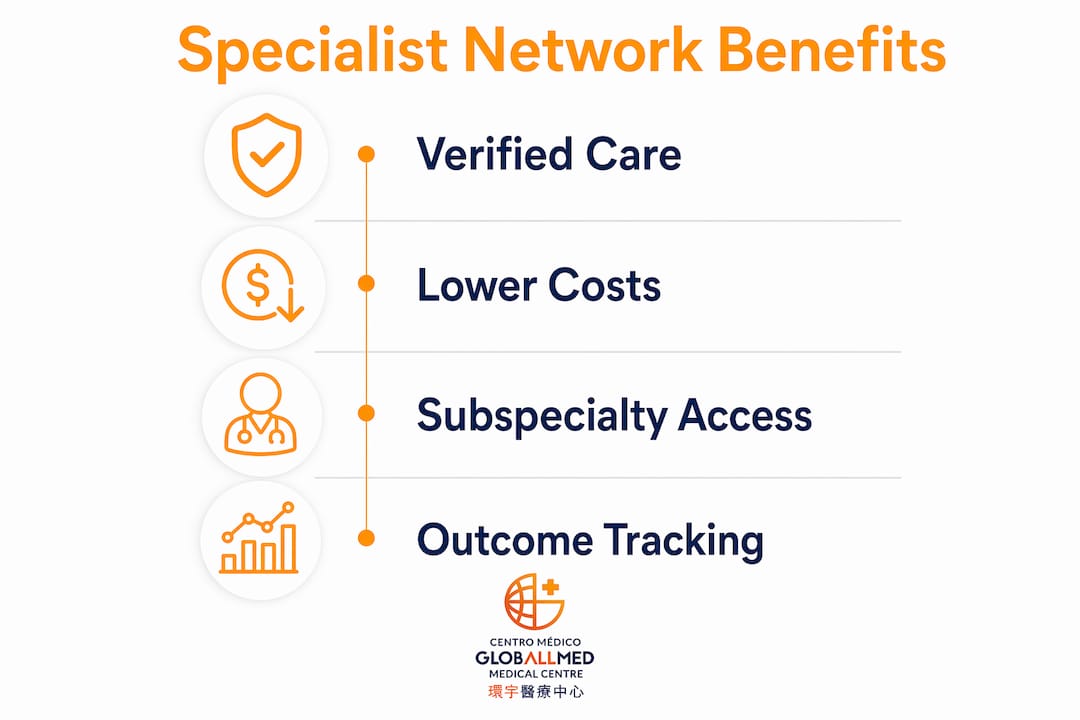
Cost reduction is the second major benefit. In-network providers carry negotiated rates with insurance plans, which directly lowers out-of-pocket expenses for patients. Some insurance plans strictly require in-network use for specialist visits, meaning patients who go outside the network face the full billed rate. Staying within a verified network is not just a clinical decision. It is a financial one.
Access to subspecialty expertise is a benefit that patients frequently underestimate. Broad specialty coverage, such as having a general surgeon in the network, is insufficient for many complex diagnoses. Plans prioritizing subspecialty adequacy outperform those focused only on general specialties, improving patient access to the precise expertise a condition requires. A patient with a rare autoimmune condition needs a rheumatologist with documented experience in that specific area, not simply any rheumatologist listed in a directory.
Care coordination is the fourth benefit, and it operates quietly in the background. Structured communication between primary care physicians and specialists reduces duplicate testing, conflicting prescriptions, and missed follow-ups. Patients who receive care within a coordinated network spend less time managing their own care logistics.
Key patient benefits at a glance:
- Lower complication rates from specialists selected on outcome data rather than availability.
- Reduced costs through negotiated in-network pricing with insurance providers.
- Subspecialty access to providers with documented expertise in specific condition areas.
- Fewer care gaps due to structured handoffs and documented communication between physicians.
- Simplified referrals through defined pathways that reduce administrative delays.
Pro Tip: Before scheduling a specialist appointment, confirm whether the network tracks outcomes by subspecialty. A network that distinguishes between a general orthopedic surgeon and a spine specialist offers meaningfully better access for complex cases.
How can patients find and verify medical specialists within a network?
Finding a qualified specialist within a network requires more than a quick search of an online directory. The process involves verification, direct confirmation, and in many cases, guidance from a primary care physician.
-
Start with your insurance provider’s directory. Most insurance plans maintain an online medical specialist directory that lists in-network providers by specialty and location. These directories are the correct starting point, but they are not always current.
-
Call the provider’s office directly. Online directories may not reflect real-time network changes, so calling the specialist’s office with your insurance ID and group number is the only reliable way to confirm current in-network status. This step prevents unexpected out-of-network billing after an appointment.
-
Ask your primary care physician for a referral. Primary care physicians who operate within a specialist network have direct knowledge of which specialists are active, credentialed, and performing well within that network. A referral from within the network carries clinical context that a directory search cannot provide. The Macau clinic referral guide published by GLOBALLMED Medical Center outlines this process clearly for patients navigating specialist care in the region.
-
Verify credentials independently. State medical boards and national licensing bodies maintain publicly accessible databases of licensed physicians. Cross-referencing a specialist’s credentials against these sources confirms their active license status.
-
Confirm subspecialty focus. A specialist listed under “cardiology” may focus primarily on general cardiac care rather than electrophysiology or structural heart disease. Confirming subspecialty focus before booking avoids mismatched appointments.
Pro Tip: Always call the specialist’s office before your first appointment to confirm both in-network status and subspecialty focus. Bring your insurance card and ask the office to verify your plan directly. This single step prevents the most common billing surprises.
Medical provider networks must meet state regulatory standards for network adequacy, including provider availability and timely access across primary care, mental health, women’s healthcare, and emergency services. Patients have the right to request network adequacy information from their insurer.
What are the structural challenges and future trends in specialist networks?
Specialist networks face significant operational challenges that affect the quality of care patients receive. The most pressing challenge is subspecialty network adequacy. Mapping a network at the subspecialty level requires far more granular data than mapping general specialty coverage. Precision in subspecialty network design is critical. Broad specialty coverage is insufficient for many complex diagnoses requiring niche expertise.
Data quality is the second structural challenge. High-performance specialty networks require data analytics capable of linking clinical events and costs to individual patient episodes. Networks that lack this infrastructure cannot differentiate between high-performing and average specialists. Patients in those networks receive no meaningful quality advantage over a traditional referral.
Technology is reshaping how networks onboard and vet specialists. AI-enabled and self-serve vetting workflows shift the registration process from synchronous phone-based calls to expert-initiated digital processes, improving specialist registration rates and reducing administrative delays. This shift allows networks to expand their specialist base more rapidly and maintain more current credentialing records.
Payment model evolution is the fourth driver of change. Programs like the Centers for Medicare and Medicaid Services (CMS) TEAM and ASM models tie specialist reimbursement directly to episode-based outcomes. That financial structure incentivizes networks to invest in the data infrastructure and accountability frameworks that produce measurable quality improvements.
| Trend | Description | Patient Impact |
|---|---|---|
| Subspecialty adequacy mapping | Networks map coverage at subspecialty level, not just general specialty | Better access to precise expertise for complex conditions |
| Episode-based analytics | Clinical and cost data linked to individual patient care episodes | Specialists selected on proven outcomes, not availability |
| AI-enabled vetting | Automated credentialing workflows replace manual phone-based processes | Faster onboarding of qualified specialists, more current directories |
| Value-based payment models | CMS TEAM and ASM models tie reimbursement to episode outcomes | Financial incentives align with clinical quality improvement |
Key Takeaways
A medical specialist network delivers measurable clinical and financial advantages only when it is built on outcome data, subspecialty precision, and verified care coordination rather than administrative contracting alone.
| Point | Details |
|---|---|
| Definition and purpose | A specialist network is an organized group of credentialed providers coordinated to improve outcomes and reduce costs. |
| Outcome-based selection | High-performance networks select specialists using episode-based data, not availability or reputation alone. |
| Cost and access benefits | In-network negotiated rates lower patient costs; subspecialty adequacy improves access for complex conditions. |
| Verification is required | Online directories may be outdated; always confirm in-network status by calling the provider directly. |
| Technology is advancing networks | AI-enabled vetting and value-based payment models are improving network quality and specialist onboarding speed. |
Why network quality matters more than network size
Most patients assume that a larger specialist network automatically means better care. That assumption is wrong. A network with thousands of listed specialists but no outcome tracking offers no clinical advantage over an informal referral. The defining factor is whether the network uses real patient data to differentiate specialist performance.
Patients often treat all in-network specialists as equally capable regardless of the complexity of their condition. True high-performance networks differentiate specialists based on outcome data, not just credential status. That distinction is invisible to most patients until something goes wrong.
The practical implication is this: when you enter a specialist network, ask the right questions. Does the network track complication rates by individual provider? Does it map subspecialty coverage, or only general specialty categories? Does it have defined communication protocols between your primary care physician and the specialist? These questions separate administrative networks from clinical ones.
Specialty networks are evolving from administrative tools into clinical integration platforms. That evolution benefits patients who know how to use them. The patients who benefit most are those who verify, ask questions, and engage with institutions that apply outcome-based standards consistently.
GLOBALLMED Medical Center applies these principles across its specialist departments in Macau. Its integrated care model connects patients to credentialed specialists through structured referral pathways and documented clinical coordination, reflecting the standards that define high-performance specialty care.
— IGHS
GLOBALLMED Medical Center’s specialist network services
GLOBALLMED Medical Center operates as Macau’s largest private outpatient clinic, providing patients with access to a coordinated network of credentialed specialists across medical, cosmetic, and wellness disciplines.
The center’s specialist departments are organized around clinical integration principles, with structured referral pathways and documented care coordination between primary care and specialty providers. Patients benefit from negotiated in-network pricing, subspecialty access, and appointment scheduling designed for both local and international patients. GLOBALLMED Medical Center’s full range of outpatient services reflects a commitment to the outcome-based standards that define effective specialist networks. Patients seeking quality specialist care in Macau can review available departments and book appointments directly through the center’s website.
FAQ
What is a medical specialist network in simple terms?
A medical specialist network is an organized group of credentialed healthcare providers who deliver specialty care under coordinated clinical agreements. These networks use outcome data and defined referral pathways to connect patients with the most appropriate specialists for their conditions.
How do specialist networks differ from a standard doctor referral?
Standard referrals rely on a physician’s personal knowledge of local providers. Specialist networks use episode-based outcome data to select and vet providers, resulting in measurably lower complication rates and more consistent care quality.
Are all in-network specialists equally qualified?
Not necessarily. Patients often treat all in-network specialists as equally capable, but high-performance networks differentiate providers based on clinical outcome data. Always confirm a specialist’s subspecialty focus and ask whether the network tracks individual performance metrics.
How do I confirm a specialist is in my network?
Call the specialist’s office directly with your insurance ID and group number. Online directories may not reflect real-time network changes, so direct confirmation before scheduling is the only reliable verification method.
Why does subspecialty coverage matter in a specialist network?
General specialty coverage is insufficient for complex diagnoses. Plans prioritizing subspecialty adequacy outperform those focused only on broad categories, giving patients access to providers with precise expertise in their specific condition area.