What Is Outpatient Travel Healthcare: A Complete Guide

Outpatient travel healthcare is defined as the delivery of medical services by traveling healthcare professionals in outpatient settings, where patients receive treatment without formal hospital admission. The industry standard contract length for traveling professionals is 13 weeks, and observation status can last up to 48 hours while still classified as outpatient care. This model serves two distinct groups: healthcare professionals seeking short-term clinical assignments in outpatient facilities, and patients who travel internationally to access specialized outpatient care. GLOBALLMED Medical Center in Macau operates precisely within this model, offering international patients access to a full range of outpatient services without requiring hospital admission.
What is outpatient travel healthcare and how does it work?
Outpatient travel healthcare combines two concepts: outpatient care delivery and the travel staffing model. Outpatient care refers to medical services provided without formal hospital admission, including same-day treatments and observation stays lasting up to 48 hours. That distinction matters because it determines billing classification, insurance coverage, and the level of clinical oversight a patient receives.
The travel staffing component means that healthcare professionals accept short-term contracts at facilities outside their home region. Standard assignments average 13 weeks, though some run shorter or longer depending on facility need. Travel professionals fill staffing gaps caused by seasonal surges, maternity leaves, and rural shortages, which benefits both the healthcare system and the clinician seeking diverse clinical exposure.

For patients, the model means access to specialty outpatient care at facilities they may not have locally. A patient traveling to Macau for orthopedic assessment or preventative screening at GLOBALLMED Medical Center is engaging with outpatient travel healthcare from the patient side. Understanding why outpatient clinics attract medical tourists helps clarify the full scope of this model.
What settings and clinical specialties are involved?
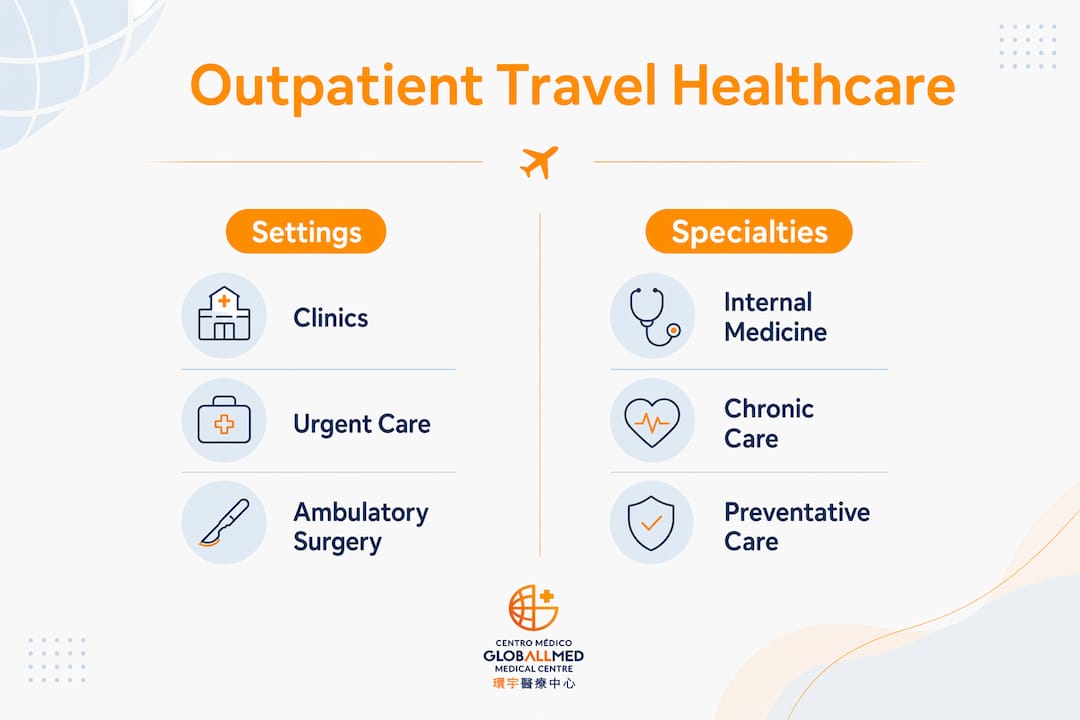
Outpatient travel healthcare is delivered across a range of facility types. Outpatient settings include clinics, urgent care centers, diagnostic facilities, and specialty practice environments. Each setting offers a different patient flow profile and clinical focus.
The table below illustrates the most common outpatient settings and their associated specialty areas:
| Setting | Common Specialties | Patient Flow Profile |
|---|---|---|
| Outpatient clinic | Internal medicine, preventative care | Scheduled, predictable |
| Urgent care center | Emergency medicine, minor trauma | Walk-in, moderate volume |
| Diagnostic center | Radiology, pathology, laboratory | Appointment-based |
| Specialty practice | Orthopedics, neurology, sports medicine | Referral-driven |
| Pediatric clinic | Pediatrics, developmental medicine | Scheduled, family-centered |
Outpatient settings offer more predictable patient flow compared to inpatient hospital environments. That predictability is a defining feature of the outpatient model and a primary reason clinicians and patients alike prefer it for planned care.
Chronic disease management and preventative care represent the largest volume categories in outpatient travel healthcare. Specialty areas such as orthopedics, sports medicine, and neurology attract both traveling professionals seeking focused clinical work and patients seeking expert consultation without a hospital stay. The scope of outpatient services continues to expand as more procedures shift away from inpatient settings.
How do contracts and logistics work in outpatient travel healthcare?
Contract structure is the operational backbone of outpatient travel healthcare for professionals. The 13-week standard exists because it balances facility staffing needs with professional flexibility. Some contracts run as short as 8 weeks for seasonal coverage, while others extend to 26 weeks for long-term gap filling.
Key contract terms every traveling professional must review before signing include:
- Shift schedule: Confirm the number of hours per week, shift length, and whether weekend or holiday coverage is required.
- Floating policy: Facilities may reassign professionals to other departments or floors. Contract fine print on floating is a common pitfall that leads to working outside your specialty without additional compensation.
- Pay package breakdown: Understand the split between taxable base pay and tax-free stipends for housing and meals.
- Documentation requirements: Clarify charting systems, credentialing timelines, and orientation expectations before arrival.
- Extension and cancellation terms: Know the notice period required by both parties and any penalties for early termination.
Getting all terms confirmed in writing before accepting an assignment is not optional. Verbal assurances from recruiters carry no contractual weight once you are on site.
Pro Tip: Maintain a legitimate tax home at your permanent residence. Tax home maintenance is the single most important financial step for traveling healthcare professionals, as it qualifies you for tax-free housing and meal stipends that significantly increase your net take-home pay.
What are the benefits and challenges of outpatient travel healthcare for professionals?
Outpatient travel roles offer a distinct financial and clinical profile compared to permanent positions. The combination of competitive base pay and tax-free stipends makes total compensation in travel roles higher than equivalent permanent staff positions in many markets. Beyond pay, the clinical diversity gained across multiple facilities and patient populations accelerates professional development in ways a single permanent role rarely does.
The professional benefits of outpatient travel healthcare include:
- Predictable scheduling: Outpatient clinics offer stable work sites and consistent hours, unlike inpatient environments where census fluctuations can alter shift length and staffing ratios.
- Specialty focus: Clinicians who prefer orthopedics, pediatrics, or neurology can target assignments that match their clinical interests rather than rotating through general units.
- Geographic flexibility: Short-term contracts allow professionals to live and work in different cities or countries, including international outpatient centers.
- Financial upside: Tax-free stipends for housing and meals, when properly structured, increase net income substantially over permanent roles.
The challenges are equally real. Adapting to new electronic health record systems, facility protocols, and team dynamics every 13 weeks requires strong professional flexibility. Floating policies can place professionals in unfamiliar clinical areas without adequate orientation. Facilities with high traveler turnover sometimes offer less mentorship and peer support than permanent staff environments.
Pro Tip: Ask detailed questions during the interview about workload, double-booking policies, and documentation expectations. Success in outpatient travel roles depends heavily on fit between the professional’s clinical style and the facility’s operational culture.
How does outpatient travel healthcare work for patients seeking care abroad?
Patients engaging with outpatient travel healthcare follow a different path than traveling professionals. For patients, the model means accessing non-inpatient services including diagnostics, minor surgeries, specialist consultations, and chronic disease management at a facility outside their home country. No formal hospital admission is required, and most treatments are completed within a single visit or a short series of appointments.
Key logistical considerations for patients seeking outpatient care abroad include:
- Scheduling and referrals: Many international outpatient clinics accept direct bookings without a local referral. Confirm this before traveling to avoid delays on arrival.
- Medical records transfer: Bring complete records including imaging, lab results, and current medication lists. Digital formats are accepted at most international facilities.
- Language and communication: Confirm that the facility has clinical staff who communicate in your preferred language. Miscommunication in a medical setting carries real risk.
- Continuity of care: Plan for follow-up after returning home. Continuity of care after travel is a critical factor in treatment outcomes, particularly for chronic conditions or post-procedure recovery.
- Insurance and payment: Verify whether your travel health insurance covers outpatient procedures abroad. Many policies distinguish between emergency outpatient care and elective outpatient treatment.
GLOBALLMED Medical Center addresses these needs directly. The center accepts international patients across a broad range of outpatient specialties, with clinical staff experienced in cross-border care coordination. Patients can review common outpatient concerns before their visit to prepare effectively.
Quality assurance is a legitimate concern when choosing an outpatient facility abroad. Patients should verify that the facility holds recognized accreditation, employs licensed specialists, and maintains clear protocols for emergency escalation if a same-day procedure requires unexpected follow-up care.
Key Takeaways
Outpatient travel healthcare requires clear contract terms for professionals and careful logistical preparation for patients to deliver safe, effective care across borders.
| Point | Details |
|---|---|
| Definition of outpatient care | Patients receive treatment without hospital admission, including observation stays up to 48 hours. |
| Standard contract length | Travel healthcare professionals typically work 13-week assignments with defined shift and pay terms. |
| Tax home advantage | Maintaining a permanent residence qualifies traveling professionals for tax-free housing and meal stipends. |
| Patient logistics abroad | Patients must arrange records transfer, confirm insurance coverage, and plan for post-visit continuity of care. |
| Outpatient setting benefits | Clinics and specialty practices offer predictable patient flow and focused clinical environments for both staff and patients. |
The contract detail most professionals overlook
Outpatient travel healthcare has matured significantly as a model, and the professionals who thrive in it share one consistent trait: they treat contract review as a clinical skill, not an administrative chore. After observing how assignments unfold across multiple outpatient settings, the pattern is clear. Professionals who negotiate floating policies, confirm documentation expectations in writing, and verify pay package structures before signing rarely encounter the disputes that derail less-prepared colleagues.
The patient side of this equation is equally underestimated. Patients who research their destination facility, confirm specialist credentials, and arrange follow-up care before traveling report far better outcomes than those who treat the trip as purely transactional. The quality gap between a well-prepared outpatient visit abroad and a poorly planned one is not about the facility. It is about preparation.
One observation that rarely appears in standard travel healthcare guides: the outpatient model actually favors patients in many respects over inpatient care. Shorter stays mean less exposure to hospital-acquired complications, more control over the care timeline, and faster return to normal activity. For elective procedures, diagnostics, and specialist consultations, outpatient care abroad at a credentialed facility is often the more medically sound choice, not just the more convenient one.
The facilities that serve international outpatient patients well share a common operational profile: clear intake processes, multilingual clinical staff, and explicit protocols for escalating care if a same-day procedure requires unexpected follow-up. GLOBALLMED Medical Center reflects this profile in its approach to international patient services, which is why it functions as a practical reference point throughout this discussion.
— IGHS
GLOBALLMED Medical Center’s outpatient services for international patients
GLOBALLMED Medical Center is Macau’s largest private outpatient clinic, offering a full range of specialty services designed for both local and international patients. The center covers medical consultation, diagnostics, preventative care, beauty and wellness treatments, and women’s and children’s health, all delivered without hospital admission.

International patients can access the complete range of outpatient services across GLOBALLMED Medical Center’s clinical departments, including the medical clinic department for specialist consultations and the women’s and children’s health program for family-focused care. Appointments are available for patients traveling from across the region. Contact the center directly through the patient inquiry page to confirm availability and schedule your visit.
FAQ
What is the difference between inpatient and outpatient care?
Inpatient care requires formal hospital admission with an overnight stay. Outpatient care covers all treatments where the patient returns home the same day, including observation stays lasting up to 48 hours.
How long do outpatient travel healthcare contracts typically last?
The standard contract length in outpatient travel healthcare is 13 weeks. Some assignments run shorter for seasonal coverage, while others extend to 26 weeks based on facility need.
Can patients receive outpatient care abroad without a local referral?
Many international outpatient clinics, including GLOBALLMED Medical Center, accept direct patient bookings without requiring a local referral. Patients should confirm this policy with the specific facility before traveling.
What financial benefits do traveling healthcare professionals receive?
Traveling professionals who maintain a legitimate tax home qualify for tax-free stipends covering housing and meals. These stipends increase net take-home pay substantially compared to equivalent permanent staff roles.
What should patients check before choosing an outpatient clinic abroad?
Patients should verify the facility’s accreditation, confirm that specialists hold recognized licenses, review the clinic’s protocol for emergency escalation, and arrange continuity of care with their home provider before traveling.