Outpatient Travel Healthcare: What Patients Need to Know

Outpatient travel healthcare is defined as the delivery of medical services by traveling healthcare professionals in clinic-based settings, where patients receive treatment without formal hospital admission. The industry-standard term for this model is “outpatient travel medicine,” and it covers both the staffing side, where clinicians take short-term contracts averaging 13 weeks, and the patient side, where individuals seek same-day care across borders. Observation status can last 24–48 hours and still qualify as outpatient care under standard regulatory definitions. GLOBALLMED Medical Center in Macau operates within this model, serving international patients through a full range of outpatient healthcare services without requiring hospital admission.
What is outpatient travel healthcare and how does it work?
Outpatient travel healthcare combines two distinct concepts: the clinical definition of outpatient care and the travel staffing model used to deliver it. Outpatient care refers to medical services provided without a formal hospital admission, including diagnostics, minor procedures, and chronic disease management where patients return home the same day. That definition matters because it sets the scope of what patients can expect: no overnight stays, no inpatient billing, and a care pathway designed around same-day resolution.
On the staffing side, travel healthcare professionals fill short-term roles at clinics and specialty facilities rather than taking permanent positions. Travel assignments average 13 weeks in 2026, though some run shorter or longer depending on facility need. This model exists because clinics face seasonal surges, staff leaves, and rural shortages that permanent hiring cannot address quickly. Travel professionals step in, maintain clinical standards, and move on, creating a flexible workforce that benefits both facilities and patients.

The patient experience in outpatient travel healthcare is straightforward. A patient schedules an appointment, receives a consultation or procedure, and leaves the same day. No admission paperwork, no inpatient room, and no extended stay. For international patients, this model is particularly practical because it fits within a short trip without requiring extended time away from home.
What settings and clinical specialties are involved?
Outpatient travel healthcare is delivered across several distinct care environments, each with its own patient flow and clinical focus. Outpatient settings include clinics, urgent care centers, diagnostic facilities, and specialty practices, all of which offer more predictable patient flow than inpatient hospital units. That predictability is a defining feature of the outpatient model. Patients arrive scheduled, receive care, and depart, rather than arriving unpredictably as in emergency or inpatient settings.
The clinical specialties most common in outpatient travel healthcare span a wide range of disciplines. Orthopedics and sports medicine attract patients seeking non-surgical joint care, physical therapy referrals, and post-operative follow-up. Pediatrics, neurology, and preventative care round out the most frequently staffed outpatient specialties. Chronic disease management, including diabetes monitoring and cardiovascular screening, is also a major driver of outpatient visits for traveling patients.
The table below illustrates the primary outpatient settings alongside their typical specialty focus and patient profile.
| Setting | Common Specialties | Typical Patient Profile |
|---|---|---|
| General outpatient clinic | Internal medicine, preventative care | Adults seeking routine or follow-up care |
| Specialty clinic | Orthopedics, neurology, sports medicine | Patients with specific diagnosed conditions |
| Urgent care center | General medicine, minor injury | Patients needing same-day unscheduled care |
| Diagnostic center | Radiology, pathology, cardiology | Patients requiring imaging or lab work |
| Wellness and aesthetics clinic | Dermatology, beauty medicine, wellness | Patients seeking elective or preventative treatments |
Pro Tip: When selecting an outpatient clinic abroad, confirm that the facility staffs licensed specialists in your specific condition rather than relying on general practitioners for specialty concerns.
How do contracts and logistics work in outpatient travel healthcare?
Contract structure is the operational backbone of outpatient travel healthcare for professionals. The 13-week standard gives both the clinician and the facility a defined engagement window, long enough to integrate into the team but short enough to maintain flexibility. Some contracts run as few as 8 weeks for urgent gap coverage, while others extend to 26 weeks for longer-term needs.
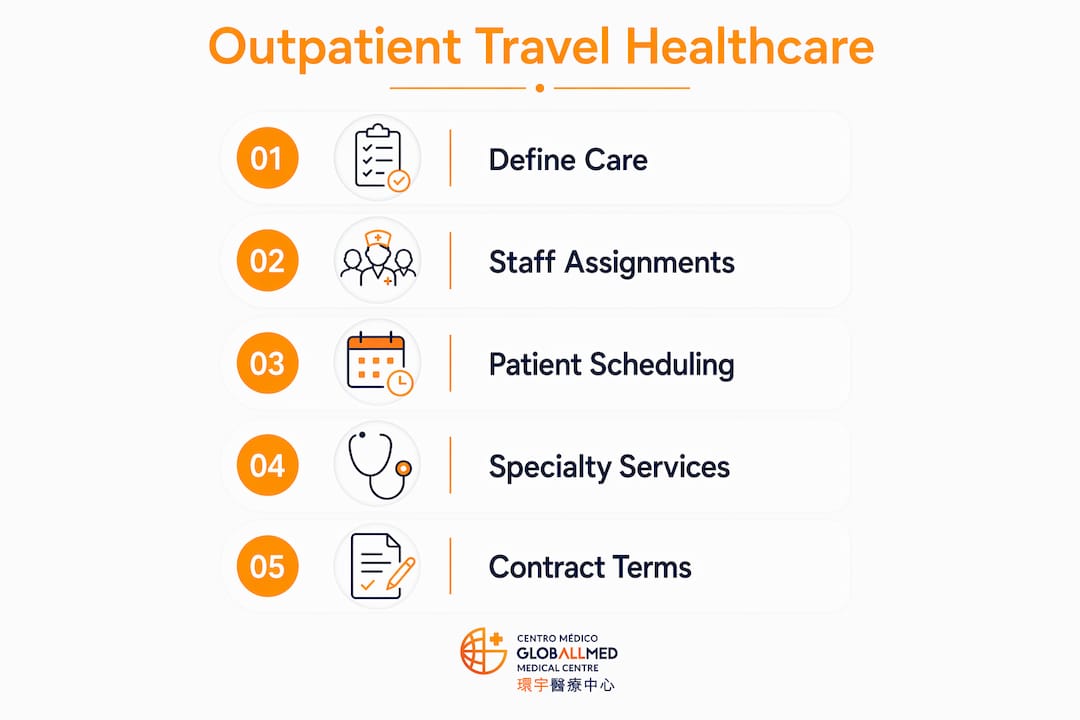
The key contract terms that professionals must review before signing include the following:
- Shift schedule and hours: Confirm the number of shifts per week, shift length, and whether weekend or holiday coverage is required.
- Floating policy: Facilities may reassign clinicians to other departments or units. Contract fine print on floating is a common pitfall that leads to working outside one’s specialty without additional pay.
- Pay package structure: Outpatient travel contracts typically combine a base hourly rate with tax-free stipends for housing and meals, provided the clinician maintains a legitimate tax home.
- Documentation requirements: Clinics vary in their electronic health record systems and charting expectations. Confirm these before arrival to avoid onboarding delays.
- Cancellation and extension clauses: Understand the notice period required by both parties if the contract ends early or extends beyond the original term.
Getting every term in writing is not optional. Verbal agreements about scheduling or floating carry no weight when disputes arise. Professionals who skip this step routinely find themselves in assignments that differ significantly from what was discussed during the interview.
Pro Tip: Maintain a legitimate tax home at your permanent residence. Tax-free stipends for housing and meals are only available to clinicians who retain a primary residence elsewhere, and this status must be documented before the contract begins, not after.
What are the benefits and challenges of outpatient travel healthcare for professionals?
Outpatient travel roles attract clinicians for a specific combination of financial and professional reasons. Outpatient settings offer more stable work sites and predictable scheduling than inpatient hospital roles, which is a primary draw for clinicians who specialize in a particular discipline and prefer consistent clinical environments. A physical therapist working in an orthopedic outpatient clinic, for example, sees a defined caseload of scheduled patients rather than managing unpredictable acute admissions.
The financial benefits are real and measurable. Tax-free housing and meal stipends increase net take-home pay compared to permanent roles at equivalent hourly rates. Clinicians who manage their tax home status correctly consistently report higher net earnings per assignment. Diverse clinical exposure across multiple facilities and geographic locations also accelerates professional development in ways that a single permanent role cannot replicate.
The challenges are equally concrete:
- System adaptation: Every new facility uses different electronic health records, documentation protocols, and internal workflows. Clinicians must adapt quickly, often without a formal orientation period.
- Floating demands: Without clear contract language, clinicians risk reassignment to units outside their specialty, which reduces both clinical effectiveness and job satisfaction.
- Isolation: Short-term assignments limit the depth of professional relationships. Clinicians who thrive on team continuity may find the travel model less satisfying over time.
- Licensing complexity: Working across different jurisdictions requires maintaining active licenses in multiple regions, which carries administrative and financial costs.
Success in outpatient travel roles depends on asking detailed questions during the interview process. Workload expectations, double-booking policies, and documentation requirements are all factors that determine whether a placement is a good fit before the contract is signed.
How does outpatient travel healthcare work for patients seeking care abroad?
For patients, outpatient travel healthcare means accessing medical services at a clinic in another city or country without being admitted to a hospital. Outpatient services include diagnostics, minor surgeries, specialist consultations, and chronic disease management, all delivered on a same-day basis. This model suits international patients well because the care pathway is contained within a single visit or a short series of appointments.
The logistical considerations for patients seeking outpatient care abroad include the following:
- Scheduling and referrals: Most outpatient clinics require advance appointments. Patients traveling internationally should book consultations before arrival and request referral letters from their home physician when relevant.
- Medical records transfer: Bringing complete medical records, including imaging files and lab results, prevents duplicate testing and speeds up the consultation process.
- Language and communication: Confirm that the clinic offers services in your language or provides interpretation. Miscommunication in a clinical setting carries direct health consequences.
- Continuity of care: Receiving treatment abroad requires a clear plan for follow-up care at home. Continuity of care after travel is one of the most frequently overlooked aspects of outpatient medical travel.
- Insurance and payment: Verify whether your travel health insurance covers outpatient consultations and procedures at the destination clinic before your appointment.
GLOBALLMED Medical Center addresses these needs directly. The center serves international patients across a broad range of outpatient specialties, with staff experienced in managing cross-border care coordination and documentation. Patients can review common outpatient concerns before their visit to prepare effectively.
Key Takeaways
Outpatient travel healthcare delivers medical services without hospital admission through short-term clinical contracts, offering patients same-day care and professionals flexible, specialty-focused assignments.
| Point | Details |
|---|---|
| Core definition | Outpatient care means no formal hospital admission; patients receive treatment and return home the same day. |
| Standard contract length | Travel healthcare professionals typically work 13-week assignments in clinic and specialty settings. |
| Contract clarity is critical | Floating policies, pay structure, and shift details must be confirmed in writing before the assignment begins. |
| Tax home status matters | Maintaining a permanent residence qualifies travel clinicians for tax-free housing and meal stipends. |
| Patient preparation | International patients should bring full medical records, confirm insurance coverage, and plan for follow-up care at home. |
The part of outpatient travel healthcare most people get wrong
The most common mistake I see in discussions about outpatient travel healthcare is treating it as a single, uniform category. It is not. The experience of a physical therapist on a 13-week orthopedic clinic contract in Macau is fundamentally different from that of a patient flying in for a specialist consultation. Both fall under the outpatient travel umbrella, but the logistics, expectations, and success factors are entirely distinct.
For professionals, the contract is everything. I have seen clinicians accept verbal assurances about floating policies and shift schedules, only to find themselves working in departments outside their specialty within the first week. The solution is not complicated: get it in writing, ask about double-booking practices during the interview, and confirm documentation expectations before you arrive. These are not bureaucratic formalities. They determine whether the assignment is professionally rewarding or a source of daily friction.
For patients, the overlooked factor is continuity. Receiving excellent outpatient care abroad means nothing if there is no clear plan for follow-up at home. The best outpatient clinics, including GLOBALLMED Medical Center, build that continuity into the care plan from the first consultation. They provide discharge summaries, imaging files, and referral letters in formats that home physicians can use immediately. That handoff is where the quality of an outpatient travel experience is ultimately measured.
The growth of outpatient medical travel in 2026 reflects a genuine shift in how patients think about accessing specialty care. Geography is no longer a barrier when the care model is designed around same-day treatment and clear documentation. The clinics that succeed in this space are the ones that treat international patients as a primary audience, not an afterthought.
— IGHS
Outpatient care at GLOBALLMED Medical Center in Macau
GLOBALLMED Medical Center is Macau’s largest private outpatient clinic, serving both local and international patients across a full range of medical, wellness, and specialty departments. The center’s model is built around same-day care delivery, with no hospital admission required for the vast majority of services.

Patients traveling to Macau for medical care can access specialist outpatient services including internal medicine, orthopedics, diagnostics, beauty and wellness treatments, and women’s and children’s health. The center’s clinical team is experienced in managing international patients, from pre-arrival scheduling through post-visit documentation. For patients who want to understand the full scope of available care before booking, the medical clinic department page provides a detailed overview of specialties and consultation options. Appointments and inquiries can be submitted directly through the center’s contact page.
FAQ
What is the difference between inpatient and outpatient care?
Inpatient care requires formal hospital admission with at least one overnight stay. Outpatient care means the patient receives treatment and returns home the same day, including observation stays of up to 48 hours.
How long are outpatient travel healthcare contracts?
The standard contract length in outpatient travel healthcare is 13 weeks, though assignments can range from 8 weeks to 26 weeks depending on the facility’s staffing needs.
Can patients receive outpatient care abroad without a referral?
Most outpatient clinics accept self-referred international patients for general consultations and diagnostics. Specialist appointments may require a referral letter from a home physician to ensure appropriate care continuity.
What should patients bring to an outpatient appointment abroad?
Patients should bring complete medical records, recent lab results, imaging files, a list of current medications, and proof of travel health insurance coverage for outpatient services.
How do travel healthcare professionals qualify for tax-free stipends?
Travel clinicians qualify for tax-free housing and meal stipends by maintaining a legitimate permanent residence, known as a tax home, that is separate from their assignment location. This status must be established and documented before the contract begins.