What Is a Bilingual Medical Consultation? Patient Guide

A bilingual medical consultation is a clinical encounter conducted in two languages, where a professional medical interpreter or bilingual clinician ensures accurate, complete communication between patient and provider. This is the standard industry term for what many patients simply call a “language-assisted appointment.” Under U.S. federal law, specifically Section 1557 of the Affordable Care Act, federally funded healthcare providers must offer language assistance to patients with limited English proficiency at no cost. That legal protection exists because miscommunication in a clinical setting is not an inconvenience. It is a patient safety risk. Whether you are navigating care in Macau, the United States, or anywhere in between, understanding how bilingual health services work puts you in control of your own healthcare.
What is a bilingual medical consultation and how does it work?
A bilingual medical consultation is a healthcare visit where two languages are used to exchange clinical information accurately and completely. The encounter relies on one of three delivery models: a certified medical interpreter present in the room, a bilingual clinician who speaks the patient’s language natively, or a remote interpretation service accessed by phone or video. Each model serves the same core goal: zero information lost between patient and provider.
The encounter follows the same structure as any standard appointment. The provider asks questions, the patient responds, and the interpreter conveys each message precisely, without summarizing, filtering, or adding personal opinion. Professional medical interpreters are trained to replicate exactly what is said, acting as a communicative channel rather than a participant in the clinical decision. That distinction matters enormously for diagnosis accuracy and informed consent.

Bilingual patient consultations are not limited to spoken language. Written materials such as discharge summaries, consent forms, and medication instructions also require translation to meet the federal standard for meaningful language access. Real-time interpretation and written translation are legally distinct requirements, and both apply in federally funded settings.
What are the different types of bilingual medical consultation services?
Medical interpretation services come in three main forms, each suited to different clinical situations. Knowing which to request before your appointment saves time and improves the quality of your visit.
-
On-site (in-person) interpretation: A certified interpreter is physically present in the exam room. This is the gold standard for complex, emotionally charged, or sensitive conversations, such as cancer diagnoses, mental health evaluations, or end-of-life discussions. Nonverbal cues, tone, and body language are fully preserved. On-site interpreters require advance scheduling, typically 24–48 hours ahead.
-
Video remote interpretation (VRI): A certified interpreter joins the appointment via a tablet or computer screen. VRI works well in telehealth settings and outpatient clinics where on-site interpreters are unavailable. It preserves visual communication and is faster to arrange than in-person services.
-
Over-the-phone interpretation (OPI): A certified interpreter connects by phone, typically within 30–60 seconds for major languages. OPI is the most accessible option for urgent or unplanned visits. It covers the widest range of languages and operates around the clock.
Language availability varies by provider. Some multilingual healthcare services support over 380 languages, making phone and video options particularly valuable for speakers of less common languages.
Pro Tip: For routine follow-ups or prescription reviews, OPI is fast and effective. Reserve in-person interpretation for any appointment where you will be discussing a new diagnosis, a surgical procedure, or a mental health concern. The stakes are higher, and the nonverbal dimension of communication matters more.
How do professional medical interpreters differ from bilingual staff or family members?
The difference between a certified medical interpreter and a bilingual staff member is not just a credential. It is a gap in training, ethics, and patient safety.
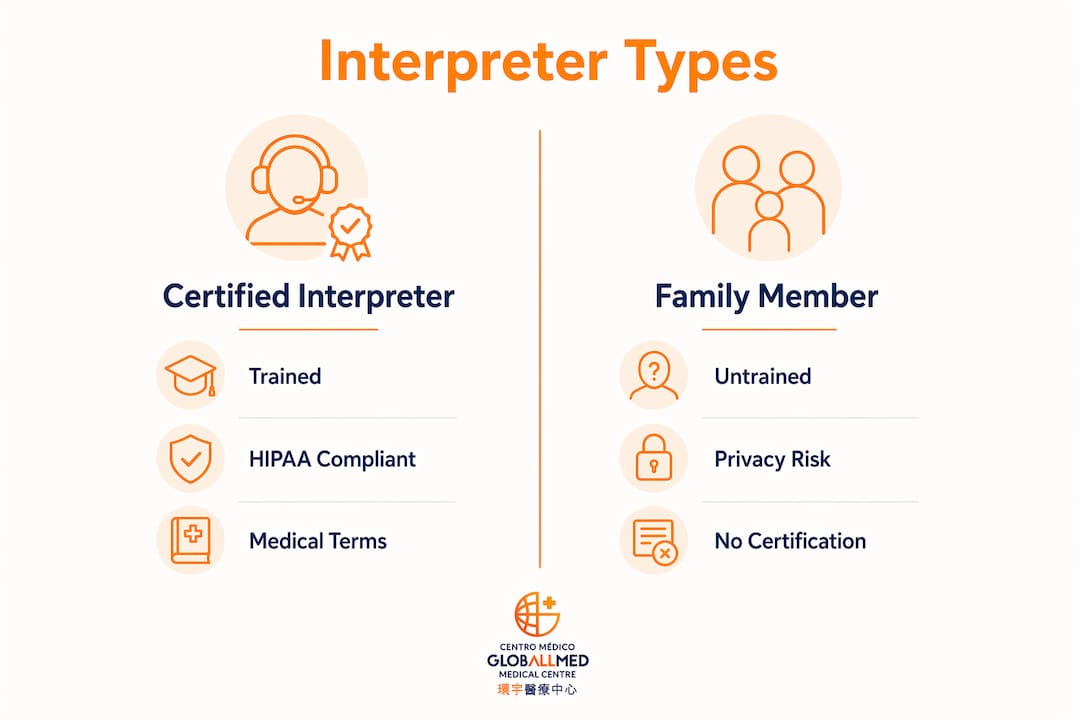
| Factor | Certified medical interpreter | Bilingual clinical staff | Family member or friend |
|---|---|---|---|
| Medical terminology training | Yes, assessed and certified | Varies, often informal | No |
| HIPAA and confidentiality compliance | Required by role | Partial, not interpreter-specific | No |
| Ethical neutrality | Strictly maintained | Not guaranteed | Rarely maintained |
| Accuracy standard | Verbatim, no omission | May summarize or filter | Frequently inaccurate |
| Patient safety risk | Low | Moderate | High |
Certified medical interpreters are trained in medical terminology, healthcare system navigation, HIPAA compliance, and ethical neutrality. Bilingual clinical staff, even those who speak a patient’s language fluently, often lack this specialized preparation. Research shows that bilingual staff without formal training may inadvertently summarize or filter information, which creates gaps in the clinical record and risks patient safety.
Using family members as interpreters introduces a different set of problems. The Joint Commission identifies untrained interpreters, including family members and especially children, as a direct patient safety risk. A family member may soften bad news, omit embarrassing symptoms, or simply not know the correct medical term. None of those outcomes serve the patient.
Relying on bilingual clinical staff for ad hoc interpretation also creates burnout and workflow disruption. A nurse pulled from patient care to interpret is not doing either job well. The BMJ Open Quality research on provider-interpreter collaboration confirms this as a systemic problem in under-resourced settings.
Pro Tip: You have the right to request a certified interpreter even when a bilingual staff member is present. Exercise that right for any appointment involving diagnosis, treatment decisions, or medication changes.
What legal rights do patients have regarding language access in healthcare?
Patients in federally funded healthcare settings have clear, enforceable rights to language assistance. These rights are not optional benefits. They are federal mandates.
-
Section 1557 of the Affordable Care Act prohibits discrimination based on national origin in any health program receiving federal funding. Language access is a core component of that protection.
-
Interpretation is free. Providers cannot charge patients for interpreter services, whether delivered in person, by video, or by phone.
-
You can request an interpreter at any point, including when scheduling, upon arrival, or mid-appointment if communication breaks down.
-
Family interpreters do not satisfy the legal standard. A provider who relies on your family member to interpret is not meeting their federal obligation.
-
Written materials must also be translated into your preferred language upon request, covering consent forms, discharge instructions, and after-visit summaries.
“Patients have the right to a professional interpreter even if bilingual clinical staff are available. Use of untrained or family interpreters is discouraged by accrediting bodies to avoid safety risks.” — National Patient Services Authority
The practical implication is straightforward. If a provider tells you that no interpreter is available and suggests your companion translate instead, that is not an acceptable substitute under federal law. You can request that the appointment be rescheduled with proper language support, or ask to speak with a patient advocate.
How can patients prepare for and book a bilingual medical consultation?
Preparation before a bilingual appointment improves accuracy and reduces the chance of miscommunication. Follow these steps to get the most from your visit.
-
Request interpretation when you book. Call ahead and specify your language and preferred modality (in-person, video, or phone). Proactive communication about language needs helps clinics allocate the right interpreter resources and prevents delays on the day of your visit.
-
Bring a complete medication list. Write down every medication you take, including dosage and frequency, in both languages if possible. This reduces the chance of errors during prescription reviews.
-
Bring prior medical records. Lab results, imaging reports, and specialist letters give your provider context that reduces the need for repeated testing and speeds up diagnosis.
-
State your language preference clearly. Do not assume the clinic has your language on file. Confirm it at check-in and again when you meet your provider.
-
Prepare your questions in advance. Write down your top three concerns before the appointment. Bilingual consultations can move more slowly due to the interpretation process, so prioritizing your questions keeps the visit focused.
-
Ask about follow-up materials. Request that after-visit summaries, prescriptions, and referral letters be provided in your preferred language. This is your right under federal law, and it supports your ability to follow through on treatment.
You can also explore the types of outpatient consultations available before booking, so you arrive knowing what kind of appointment best fits your needs.
What are the benefits of bilingual medical consultations for patient outcomes?
The benefits of bilingual medical care extend well beyond comfort. They directly affect clinical accuracy, treatment success, and long-term health.
-
Fewer diagnostic errors. When patients can describe symptoms fully and accurately in their native language, providers receive more complete information. Miscommunication is one of the most common causes of misdiagnosis, and bilingual consultations reduce that risk measurably.
-
Better medication adherence. Patients who understand their treatment plan in their own language are more likely to follow it correctly. Studies confirm that culturally competent bilingual care leads to better health outcomes and higher patient satisfaction scores.
-
Greater patient trust. Speaking in your native language removes a layer of stress from an already stressful situation. That comfort translates into more honest, complete conversations with your provider.
-
Culturally competent care. Cultural competence goes beyond language. Understanding a patient’s cultural context, including attitudes toward medication, family roles in decision-making, and beliefs about illness, builds the kind of trust that makes treatment effective. As the Suffolk Health research notes, cultural and social context is as important as linguistic accuracy.
-
Reduced health disparities. Language barriers are a documented driver of health inequality. Patients with limited English proficiency who lack interpreter access receive lower-quality care, experience more adverse events, and have worse outcomes than English-speaking patients with equivalent conditions.
The importance of medical consultations is well established. Adding language access to that equation is not a luxury. It is the baseline for equitable care.
Key takeaways
A bilingual medical consultation is the most direct tool patients have to protect their safety, exercise their legal rights, and receive care that actually works for them.
| Point | Details |
|---|---|
| Definition is clear | A bilingual consultation uses two languages via a certified interpreter or bilingual clinician to ensure accurate clinical communication. |
| Three service modalities exist | On-site, video remote, and over-the-phone interpretation each suit different clinical situations and urgency levels. |
| Certified interpreters are not optional | Bilingual staff and family members do not meet federal standards and introduce measurable patient safety risks. |
| Legal rights are enforceable | Section 1557 of the Affordable Care Act requires federally funded providers to offer free interpretation at no cost to the patient. |
| Preparation improves outcomes | Requesting interpretation at booking, bringing medication lists, and preparing questions in advance all improve consultation quality. |
Why I think most patients underestimate their right to language access
Most patients I have observed in diverse healthcare settings do not know they can demand a certified interpreter. They accept whatever the clinic offers, whether that is a bilingual receptionist, a family member, or a phone app. That acceptance is understandable. Healthcare settings are stressful, and most patients do not arrive knowing their rights.
The uncomfortable truth is that the system often relies on that ignorance. Certified interpretation costs money and requires scheduling. It is easier for a clinic to hand a patient a tablet with a translation app and call it done. That is not language access. That is a workaround that puts the patient at risk.
What I have seen work consistently is patients who advocate for themselves before they arrive. They call ahead, they name their language, and they ask specifically whether a certified interpreter will be present. That single act changes the dynamic entirely. Clinics that know a patient is informed tend to prepare properly.
The other point worth making is that cultural competence is not the same as language fluency. A provider who speaks your language but does not understand your cultural context around illness, family, or treatment can still miss the mark. The best bilingual consultations combine linguistic accuracy with genuine cultural awareness. That combination is what produces real trust and real outcomes.
Advocate for both. You are entitled to them.
— IGHS
Book a bilingual consultation at GLOBALLMED Medical Center
GLOBALLMED Medical Center in Macau offers multilingual healthcare appointments designed for international and local patients who need clear, accurate communication with their clinical team. Whether you need an in-person consultation, a video-assisted visit, or phone-based interpretation support, GLOBALLMED Medical Center provides language-assisted care across a full range of outpatient services.
The clinical team at GLOBALLMED Medical Center is experienced in working with patients from diverse linguistic and cultural backgrounds. Every consultation is structured to protect your right to understand and be understood. Explore the full range of available clinical services and book your appointment with confidence that your language needs will be met from the first call to the final follow-up.
FAQ
What is a bilingual medical consultation in simple terms?
A bilingual medical consultation is a healthcare appointment where a certified interpreter or bilingual clinician helps a patient and provider communicate accurately in two languages. The goal is complete, safe information exchange with no details lost or altered.
Is a bilingual medical consultation free for patients?
Under Section 1557 of the Affordable Care Act, federally funded providers must offer professional interpretation at no cost to the patient. You should never be charged for an interpreter in a qualifying healthcare setting.
Can I use a family member as my interpreter at a medical appointment?
Using a family member is discouraged by The Joint Commission and does not meet federal standards for language access. Family members may omit, soften, or misinterpret clinical information, which creates patient safety risks.
How do I request a bilingual consultation when booking an appointment?
Call the clinic when scheduling and specify your language and preferred interpretation method (in-person, video, or phone). Bringing your medication list and prior records also helps the interpreter and provider work more efficiently.
What is the difference between medical interpretation and medical translation?
Interpretation is real-time spoken communication during a clinical encounter. Translation applies to written documents such as consent forms or discharge summaries. Both are required under federal law for meaningful language access, but they serve different functions in patient care.