Medical Tourism Safety Standards Explained for Patients

Medical tourism safety standards are the measurable criteria and accreditations that confirm healthcare providers abroad meet internationally accepted quality and patient safety benchmarks. If you are considering treatment in another country, understanding these standards is not optional. It is the difference between receiving care comparable to what you would get at home and walking into a facility with no meaningful oversight. Key bodies like Joint Commission International (JCI), national health authorities such as Thailand’s Hospital Accreditation (HA) and Mexico’s General Health Council, and specialized medical travel insurance providers form the backbone of this global safety framework. Knowing how to read these credentials before you book protects your health and your money.
What are the main medical tourism safety accreditations?
Medical tourism accreditation explained simply: it is a formal certification that a healthcare facility meets defined standards for clinical quality, patient safety, and operational integrity. Not all accreditations carry equal weight, and knowing the difference matters before you choose a provider.
Joint Commission International (JCI) is the gold standard. The JCI accreditation process involves a rigorous multi-day on-site evaluation covering nearly 1,300 measurable safety and quality criteria, and it is valid for three years. That means a JCI-accredited hospital has been audited recently and must maintain those standards to keep its status. JCI-accredited facilities exist in over 70 countries, including major medical tourism destinations like Thailand, Mexico, Turkey, and the United Arab Emirates.

National accreditations complement JCI by adding region-specific oversight. National health authorizations such as Thailand’s HA, Mexico’s General Health Council, and Turkey’s Health Tourism Authorization certificate often enforce requirements for bilingual staff, patient rights compliance, and mandatory insurance coverage for international patients. China’s Grade-A Tertiary designation is the domestic equivalent for its top-tier public hospitals. These national credentials are not inferior to JCI. They address local regulatory realities that a global standard cannot always capture.
ISO 9001 certification is a common source of confusion. ISO 9001 certifies a clinic’s quality management processes, such as records handling and administrative workflows, but it does not assess physician competence or clinical patient safety. A clinic can hold ISO 9001 and still have surgeons with no verifiable board certification. Do not treat ISO certification as proof of clinical safety.
Pro Tip: Always verify a surgeon’s board certification directly with the relevant national medical board, not just through the clinic’s own marketing materials. A facility can be accredited while individual physicians within it are not.
| Accreditation | Scope | Renewal Cycle | Key Requirement |
|---|---|---|---|
| JCI | Clinical and operational safety | Every 3 years | 1,300+ measurable criteria |
| Thailand HA | Regional clinical standards | Every 3 years | Patient rights and bilingual staff |
| Mexico General Health Council | National hospital licensing | Annual review | Facility and physician licensing |
| Turkey Health Tourism Authorization | International patient services | Annual | Insurance and patient rights |
| ISO 9001 | Business process quality | Every 3 years | Administrative systems only |
How do safety standards affect patient outcomes and risks?
The gap between accredited and unaccredited facilities is not theoretical. Unaccredited clinics in developing countries can have surgical site infection rates up to three times higher than U.S. benchmarks, while accredited facilities with JCI or top-tier national certification maintain complication rates comparable to domestic standards. That statistic should anchor every decision you make about where to receive care abroad.
“Accreditation is not a marketing badge. It is an operational commitment to maintaining specific clinical protocols, staff training, and patient safety systems that are independently verified.”
The risks extend beyond infection rates. Non-clinical factors, including logistical confusion, language barriers, and emotional stress, directly affect recovery outcomes. A patient who cannot clearly communicate symptoms to a nurse, or who misunderstands post-operative instructions, faces real clinical risk even in a technically competent facility.
Common oversights that increase risk include:
-
Choosing a provider based on price alone without verifying accreditation status.
-
Failing to obtain a written treatment quote that details clinical assumptions, inclusions, and follow-up care.
-
Skipping a pre-travel consultation with your home physician to assess fitness for travel post-surgery.
-
Ignoring informed consent documents or signing forms without legal review.
-
Underestimating recovery time and booking return flights too soon after a procedure.
Pro Tip: Request the facility’s most recent accreditation certificate and cross-reference it on the JCI or relevant national authority’s public database. Certificates can be forged; the database cannot.
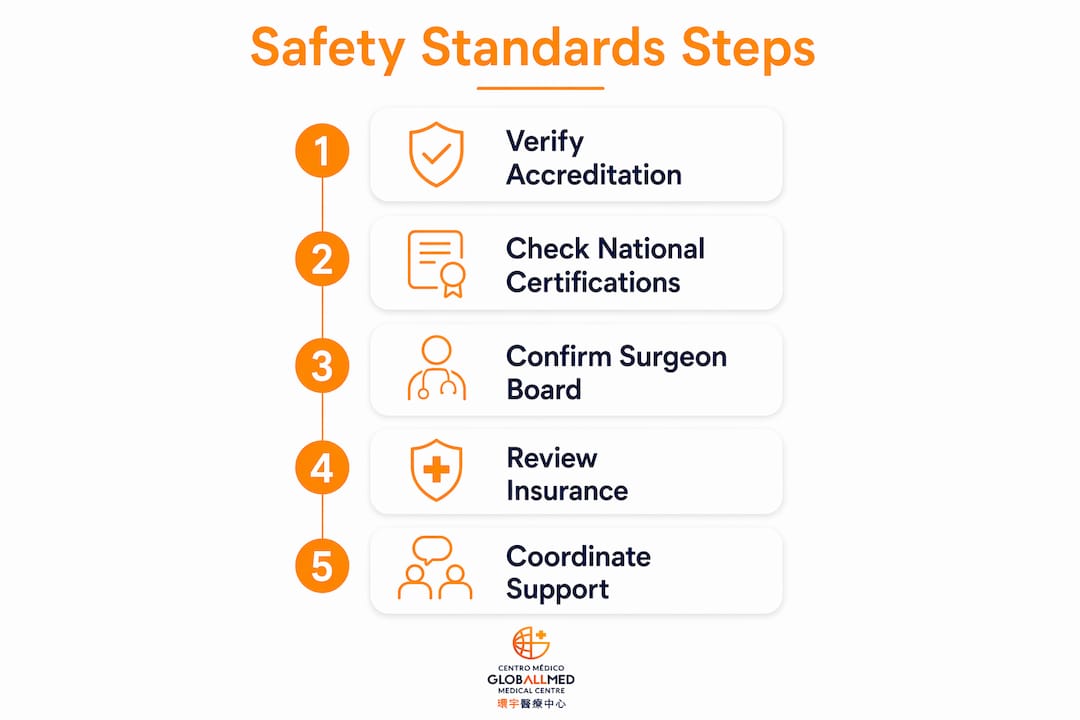
Understanding medical center safety guidelines before you travel gives you a concrete checklist to evaluate any provider, not just a general sense of reassurance.
What are the limits of insurance and legal protections?
Medical tourism legal protections explained honestly: they are weaker than most patients expect. Standard health and travel insurance policies rarely cover complications from planned medical tourism procedures. Specialized medical tourism insurance extends coverage for up to 180 days after treatment, which matters enormously when complications surface weeks after you return home. That 180-day window is the benchmark you should demand from any policy you purchase before traveling.
Legal recourse is even more limited. Cross-border malpractice claims are complex, expensive, and governed by destination country laws with limited recovery options. Suing a clinic in Thailand from your home country in the United States is not practically viable for most patients. The legal costs alone often exceed any potential settlement.
Key insurance and legal risks to understand before you travel:
-
Standard travel insurance excludes elective procedures and their complications.
-
Many international clinics include arbitration clauses in consent forms that legally restrict your right to pursue court action in disputes.
-
Destination country courts apply local law, which may cap compensation far below U.S. or European standards.
-
Repatriation coverage, meaning the cost of medical transport home if something goes wrong, is a separate policy add-on that most patients forget to purchase.
-
Your home country’s patient rights laws do not follow you abroad.
The practical takeaway is straightforward. Purchase specialized medical tourism insurance before you travel, read every consent form before signing it, and have a lawyer review any document containing arbitration language. These steps will not eliminate risk, but they give you real protection rather than false comfort.
How does personalized patient support improve medical travel safety?
Personalized patient support is the most underrated safety factor in medical tourism. Coordinated patient support services cover treatment coordination, travel logistics, physician-to-patient communication, and emotional guidance. They reduce confusion and stress in ways that directly improve clinical outcomes. A patient who understands their treatment plan and feels supported is more likely to follow post-operative instructions correctly.
The medical tourism patient experience explained at its best looks like this: a dedicated coordinator who manages your consultation schedule, translates medical documents, arranges local transport, and follows up with your home physician after you return. That level of support is not a luxury. It is a safety mechanism.
Watch out for commission-based facilitators. Some medical tourism agencies earn referral fees from specific clinics, which creates a conflict of interest. Their recommendation may reflect their commission structure, not your clinical needs. Ask any facilitator directly how they are compensated before accepting their guidance.
Best practices for verifying quality patient support:
-
Confirm the provider offers a dedicated point of contact throughout your entire care journey, from pre-travel consultation to post-procedure follow-up.
-
Ask whether the coordinator is a licensed healthcare professional or an administrative agent.
-
Request a transparent treatment quote in writing before you commit, one that specifies what is included, what assumptions were made remotely, and what follow-up care is covered.
-
Verify that the provider offers access to multiple hospital options, not just one affiliated facility.
Pro Tip: Ask your coordinator to provide a written post-treatment plan before you travel, not after your procedure. Providers who cannot produce this document in advance are not operationally prepared for complications.
Learning about medical concierge services can help you understand what genuine patient-centered support looks like versus what is simply a booking service with a premium label.
Key takeaways
Medical tourism safety is determined by accreditation quality, insurance coverage, legal awareness, and coordinated patient support working together, not by price or destination reputation alone.
| Point | Details |
|---|---|
| JCI is the benchmark accreditation | JCI covers 1,300+ criteria and requires renewal every three years, making it the most reliable global standard. |
| Unaccredited facilities carry measurable risk | Surgical site infection rates at unaccredited clinics can be three times higher than U.S. domestic benchmarks. |
| Standard insurance does not cover you | Purchase specialized medical tourism insurance that covers up to 180 days post-procedure before you travel. |
| Legal protections are limited abroad | Cross-border malpractice claims are governed by destination laws; arbitration clauses further restrict your options. |
| Patient support is a clinical safety factor | Coordinated support reduces stress and miscommunication, both of which directly affect recovery outcomes. |
What i have learned about navigating these standards
Most patients research the destination before they research the provider. That is the wrong order. The country matters far less than the specific facility’s accreditation status, the surgeon’s verifiable credentials, and the quality of support infrastructure around your care.
The single most common mistake I see is patients accepting a price quote as a proxy for quality. A low price at an unaccredited facility is not a deal. It is an unpriced risk. The cost of managing a complication at home, including emergency care, extended recovery, and corrective procedures, routinely exceeds the original savings.
Written, transparent treatment quotes are non-negotiable. An ethical provider will tell you exactly what clinical assumptions underlie their cost estimate, what follow-up is included, and what happens if something goes wrong. If a clinic cannot produce that document before you travel, walk away.
On insurance and legal protections: be realistic. Specialized coverage is available and worth every dollar. But no insurance policy replaces the protection of choosing an accredited provider with a verified track record. Legal recourse abroad is slow, expensive, and uncertain. Your best legal protection is choosing a provider who makes legal action unnecessary.
Finally, advocate for yourself. Ask hard questions. Request documentation. Verify credentials independently. The providers worth trusting will welcome that scrutiny.
— IGHS
Why GLOBALLMED medical center supports safer medical travel
GLOBALLMED Medical Center operates as Macau’s largest private outpatient clinic, built around international healthcare standards and a patient-first care model. Every department is staffed by board-certified specialists, and the center’s compliance with international safety protocols means you receive care that meets the benchmarks this article describes.

From your first consultation through post-treatment follow-up, GLOBALLMED Medical Center provides coordinated patient support designed to reduce the confusion and stress that undermine outcomes in medical travel. Whether you are exploring outpatient medical services or planning a comprehensive health checkup, the center’s team manages every step with transparency and clinical accountability. Explore the full range of available services and book your consultation directly through the GLOBALLMED Medical Center website.
FAQ
What does JCI accreditation mean for patients?
JCI accreditation means a hospital has passed an independent evaluation covering nearly 1,300 safety and quality criteria and must repeat that evaluation every three years. It is the most reliable international signal that a facility meets clinical safety standards comparable to top domestic providers.
Is medical tourism safe at accredited facilities?
Accredited facilities with JCI or equivalent national certification maintain complication rates comparable to U.S. domestic benchmarks. Unaccredited clinics can have surgical site infection rates up to three times higher, so accreditation status is the single most important safety filter.
Does travel insurance cover medical tourism complications?
Standard travel and health insurance policies do not cover complications from planned medical tourism procedures. Specialized medical tourism insurance covers up to 180 days post-procedure and is the only policy type that provides meaningful protection.
Can i sue a foreign clinic if something goes wrong?
Cross-border malpractice claims are governed by destination country laws and are expensive and slow to pursue. Many clinic consent forms include arbitration clauses that further restrict your right to court action, so legal review of all documents before signing is critical.
What should a transparent treatment quote include?
A written treatment quote from an ethical provider must specify the clinical assumptions behind the cost estimate, what services are included and excluded, and what follow-up care is covered after the procedure. Any quote that omits these details is incomplete and should be questioned before you commit.