
Defining Medical Concierge Service: What Families Need to Know

Most people assume that a medical concierge service is simply a fancy way of saying “pay more to skip the waiting room.” That misconception sells the concept short and leaves families confused when they encounter very different offerings under the same label. Defining medical concierge service accurately means understanding that it covers at least two distinct categories: physician-based membership models and in-home concierge nursing care. Both promise more personalized attention than standard healthcare, but they work differently, cost differently, and serve different needs. This guide breaks down both models clearly so you can decide which, if either, fits your family.
Table of Contents
- Key takeaways
- Defining medical concierge service: the physician model
- Concierge nursing and in-home care
- Comparing the models: costs, billing, and coverage
- Benefits and challenges for individuals and families
- How to evaluate and choose a concierge service
- My perspective on how this model is evolving
- Experience personalized care at GLOBALLMED Medical Center
- FAQ
Key takeaways
| Point | Details |
|---|---|
| Two core models exist | Physician concierge medicine and concierge nursing are both “concierge care” but serve very different purposes. |
| Fees work differently by model | Hybrid physician models bill insurance plus a retainer, while direct primary care is direct-pay with no insurance billing. |
| Nursing concierge fills a gap | Concierge nurses provide one-on-one in-home care that is particularly valuable after hospital discharge or for chronic conditions. |
| Cost and equity are real factors | Membership fees range widely and may be unaffordable for many families, so evaluating financial fit matters before committing. |
| Membership agreements need scrutiny | Read exactly what services are included, what the fees cover, and what the termination terms are before signing. |
Defining medical concierge service: the physician model
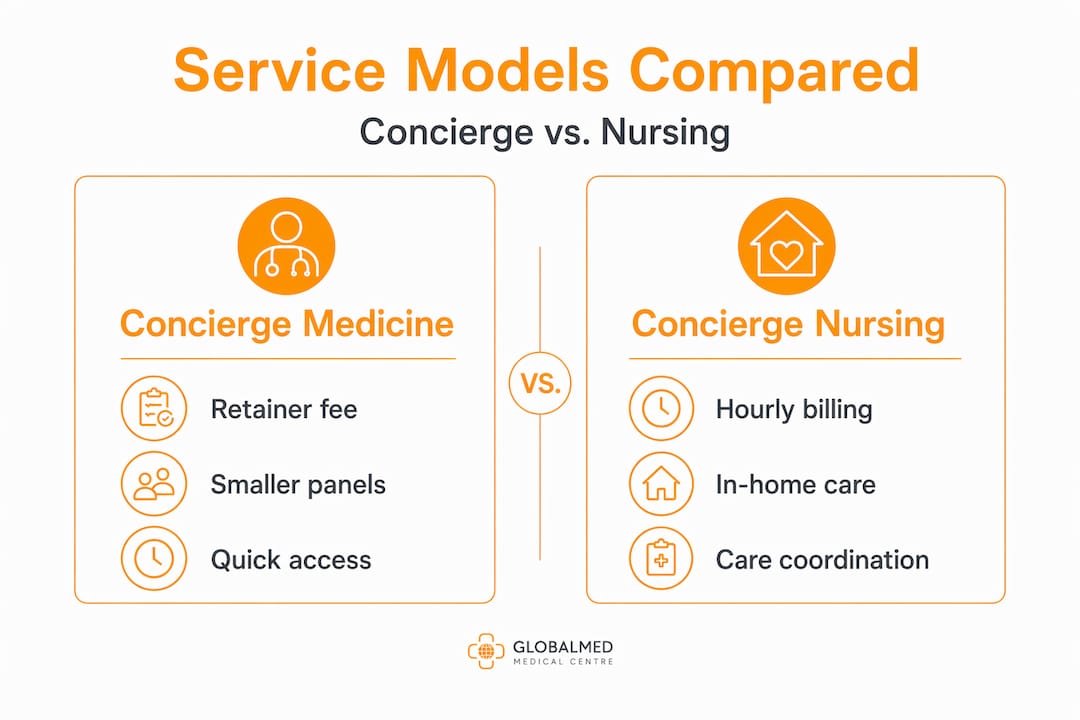
The most widely recognized form of concierge medicine is the physician membership model, sometimes called retainer medicine. A patient pays an annual or monthly fee directly to their physician or practice. In exchange, they receive a level of access and attention that standard insurance-based care simply does not offer.
What does that access look like in practice? Same-day appointments are standard, and many practices guarantee responses to calls, texts, or emails within hours. Compare that to the national average wait of 26 days for a new patient appointment in conventional medicine. The difference is not cosmetic. For a parent managing a child’s recurring respiratory issues or an older adult coordinating multiple specialists, faster access changes outcomes.
The reason that kind of access is possible comes down to panel size. Concierge physicians typically see 200 to 600 patients, compared to 2,000 or more in a standard primary care practice. Fewer patients means longer visits, typically 30 to 90 minutes, and a physician who actually remembers your history without needing to skim the chart for the first five minutes.
Two physician concierge models you need to distinguish
Not all physician concierge practices work the same way financially. There are two main structures, and confusing them leads to unpleasant billing surprises.
- Hybrid concierge model: The physician charges a membership fee on top of continuing to bill your insurance for actual clinical services. Membership fees cover enhanced access and amenities such as direct phone access and priority scheduling, while insurance still handles the clinical billing. You need to maintain your existing insurance.
- Direct primary care (DPC): The physician charges a flat monthly fee, typically lower than hybrid retainers, and does not bill insurance at all. The fee covers most primary care visits, basic labs, and care coordination. You still need insurance for specialist referrals, hospitalizations, and advanced diagnostics, but your primary care costs are entirely predictable.
Pricing for traditional concierge medicine typically runs between $1,500 and $10,000 or more per year, with a national average around $2,500 to $3,000 annually. Direct primary care tends to run $50 to $150 per month per adult, making it more accessible for working families.
Pro Tip: If your family already has solid insurance coverage, a direct primary care arrangement can eliminate most copays and unpredictable primary care bills without adding a large annual retainer on top.
Concierge medicine originated in the late 1990s in Seattle and has since spread well beyond primary care. Cardiologists, dermatologists, and orthopedic surgeons now offer concierge models, which means the concept of personalized medical services is no longer limited to family medicine.
Concierge nursing and in-home care
Here is where many families get caught off guard. The term “medical concierge” does not always mean a physician at all. Concierge private duty nursing refers to a registered nurse who provides intensive, individualized care in your home or a private setting, working exclusively for one patient at a time.
This is meaningfully different from standard home health nursing. A typical home health nurse may visit for 30 to 60 minutes a few times a week and work from a standardized care plan. A concierge private duty nurse develops a fully customized care plan, anticipates individual preferences, and maintains continuity of care across every visit. The relationship is one patient, one nurse, with no divided attention.
The services that fall under concierge nursing commonly include:
- Medication administration and management
- Chronic condition monitoring (diabetes, heart failure, COPD)
- Post-operative and post-discharge support
- Wound care and IV therapy at home
- Coordination with the treating physician and specialist team
- Health education for the patient and family caregivers
That last point matters more than people realize. One of the highest-risk periods in healthcare is the first two weeks after hospital discharge. Patients return home with new medications, unfamiliar equipment, and follow-up instructions they may not fully understand. A concierge nurse who manages that transition dramatically reduces the chance of readmission.
Pro Tip: When evaluating concierge nursing, ask specifically whether the nurse will manage care coordination with your doctors or simply provide companionship and basic monitoring. The scope varies significantly between providers, and the distinction affects outcomes.
Families managing elderly parents, children with complex medical needs, or adults recovering from major surgery are the most common clients for concierge nursing. The value is not luxury. It is clinical continuity that the standard system often fails to provide.

Comparing the models: costs, billing, and coverage
Understanding how each model handles money and insurance is the most practical piece of information you can have before making any decisions. The table below summarizes the key differences.
| Feature | Hybrid concierge medicine | Direct primary care | Concierge private duty nursing |
|---|---|---|---|
| Primary provider | Physician | Physician | Registered nurse |
| Fee structure | Retainer + insurance billing | Flat monthly fee, no insurance billing | Hourly or daily private pay rate |
| Insurance required | Yes, for clinical services | Yes, for specialists and hospital | Rarely covered; typically private pay |
| Typical cost | $2,500 to $10,000+ per year | $50 to $150 per month per adult | $35 to $100+ per hour depending on scope |
| Panel or patient ratio | 200 to 600 patients per physician | Similar reduced panel | One patient per nurse per shift |
| Best for | Patients wanting premium physician access with insurance | Families wanting predictable primary care costs | Post-discharge, chronic illness, or complex home care |
The financial structure is the single most important factor for families to clarify before enrolling. Whether the membership fee is layered on top of your existing insurance or replaces insurance billing entirely changes how you budget and what you still need to purchase separately.
From a regulatory standpoint, hybrid concierge practices must be careful not to bill insurance for services already covered by the retainer fee. That creates compliance exposure. Direct primary care practices operate outside the insurance billing system for primary care, which simplifies their compliance burden considerably.
Benefits and challenges for individuals and families
The benefits of concierge medicine are real. They are also not equally available to everyone, and honest families need both sides of the picture.
What concierge care genuinely delivers
The primary advantages are consistent across physician and nursing models:
- Faster access: Wait times drop from weeks to hours or same-day.
- Longer visits: Physicians have time to listen, which changes diagnosis quality.
- Care coordination: Concierge providers actively manage referrals, follow-ups, and communication across your care team.
- Preventive focus: Smaller patient panels allow preventive care strategies to be individualized rather than rushed.
- Reduced administrative friction: Less time on hold, fewer billing surprises, more direct communication.
Patient satisfaction in concierge practices is consistently higher than in conventional settings. The reason is straightforward: when a physician has time for you and knows your history, the care feels different and often is different.
The challenges you should not ignore
Concierge care raises equity concerns that clinicians and legislators have flagged repeatedly. When experienced physicians shift to concierge models, they reduce their patient panels sharply. For every 600-patient concierge practice, roughly 1,400 former patients need to find new primary care physicians in a system already short on supply. The systemic pressure on primary care access for non-concierge patients is a legitimate concern.
Cost is the other barrier. At $2,500 or more per year before insurance costs, physician concierge care is simply out of reach for many families. Direct primary care is more affordable, but still adds a monthly cost to existing insurance premiums.
Pro Tip: If full concierge membership is not financially feasible, look for outpatient consultation types that offer some elements of personalized access without requiring an annual retainer.
How to evaluate and choose a concierge service
Once you have decided to explore concierge care seriously, the evaluation process is where most families make avoidable mistakes. Here is a practical sequence to follow:
- Clarify the model first. Ask directly: Is this a hybrid model that bills insurance, or a direct primary care arrangement? Is this a physician practice or a nursing service?
- Request the membership agreement in advance. Membership agreements must clearly state included services, fees, how insurance is handled, and termination terms. Never sign without reading these in full.
- Ask about panel size or patient-to-nurse ratios. This tells you how much attention you will realistically receive.
- Confirm what the fee covers versus what insurance will still be billed for. The line between “retainer services” and “billable clinical care” is where surprises happen.
- Assess fit with your family’s health profile. Concierge nursing is ideal for complex or post-acute care. Concierge medicine is best suited to families who need frequent primary care access or want a physician who truly knows them over time.
- Evaluate the provider’s background and references. Concierge care is a premium service. Vetting the provider’s credentials, communication style, and patient reviews is not optional.
Integrating a concierge provider with your existing insurance and specialist relationships also requires a conversation upfront. The concierge provider should be willing to communicate directly with your other physicians, not operate as a separate silo.
My perspective on how this model is evolving
I have seen families transformed by concierge care choices and others who felt they overpaid for access they rarely used. Both outcomes are preventable if the decision is made carefully.
What I find most encouraging about concierge medicine is the renewed emphasis on the physician-patient relationship. When a doctor has 500 patients instead of 2,000, they show up differently. That is simply true. The care becomes longitudinal in a way that actually matters for prevention and chronic disease management.
What concerns me is the equity dimension. As concierge models grow in popularity, primary care capacity for everyone else contracts. That trade-off deserves more attention than it typically gets in promotional content about concierge services. I think families exploring this option owe it to themselves to ask not just “Is this good for us?” but also “What does this model do to the system around us?”
My honest advice: if cost is a stretch, look seriously at direct primary care before committing to a high-retainer hybrid model. The access improvements are similar, the costs are dramatically lower, and you maintain full insurance coverage for everything beyond primary care. For families navigating post-discharge complexity or aging parents with chronic conditions, concierge nursing may offer more immediate value than a physician membership anyway.
Concierge care is not inherently the future of healthcare. But chosen deliberately, for the right reasons, it can offer something the standard system rarely does: a provider who has the time to actually know you.
— IGHS
Experience personalized care at GLOBALLMED Medical Center

GLOBALLMED Medical Center, Macau’s largest private outpatient clinic, is built around the principles that make concierge care compelling: direct access to experienced providers, personalized attention, and care that is coordinated rather than fragmented. Whether you are exploring outpatient medical services for primary care needs or looking for specialized support through the women and child health department, GLOBALLMED brings international-standard healthcare to Macau with a patient-centered approach. Families, international patients, and medical tourists consistently find that the clinic’s integrated model removes the friction that typically slows down care. Explore the full range of GLOBALLMED services or contact the team directly to discuss which care pathway fits your health goals.
FAQ
What is a medical concierge service?
A medical concierge service is a healthcare model where patients pay a membership or retainer fee in exchange for enhanced access, personalized care, and greater physician or nursing availability compared to standard insurance-based care.
How does concierge healthcare work financially?
In hybrid physician models, patients pay a retainer fee and still use insurance for clinical billing. In direct primary care, patients pay a flat monthly fee with no insurance billing for primary care. Concierge nursing is typically private pay by the hour or shift.
What is the difference between concierge medicine and direct primary care?
Concierge medicine generally charges higher retainer fees and continues billing insurance for clinical services, while direct primary care charges a lower flat monthly fee and operates entirely outside insurance billing for primary care visits.
Who benefits most from a concierge medical service?
Families with frequent primary care needs, older adults managing chronic conditions, and patients recovering from surgery or hospital discharge typically see the greatest benefit from physician concierge or concierge nursing models.
Are there downsides to concierge medicine?
Yes. Membership costs can be prohibitive for many families, and the shift of physicians to smaller concierge panels reduces primary care access for patients who remain in the conventional system.