Why medical consultations are vital: lifesaving benefits

Skipping a routine doctor’s visit feels harmless until it isn’t. Many people operate under the assumption that medical care is only necessary when something goes seriously wrong. But skipping consultations increases premature mortality and emergency hospital visits in measurable, preventable ways. Whether you’re a Macau resident managing a busy schedule or an international patient navigating an unfamiliar healthcare system, understanding the true value of regular medical consultations could be the most important health decision you make. This guide breaks down what consultations actually do, what happens when you avoid them, and how Macau’s outpatient model sets a strong example for proactive care.
Table of Contents
Key Takeaways
| Point | Details |
|---|---|
| Early detection and prevention | Medical consultations help find and address health issues before they become severe or costly. |
| Continuity equals better outcomes | Staying connected with a healthcare provider lowers your risk of hospitalization and complications. |
| Personalized, adaptable care matters | Consultation length and content should match each individual’s needs, especially for complex cases. |
| Specialist access improves results | Accessing multidisciplinary teams through consultations ensures expertise for chronic or complicated issues. |
The essential role of medical consultations in health outcomes
A medical consultation is more than a quick check-in. It’s a structured clinical encounter where your doctor reviews your health history, performs or orders diagnostics, evaluates symptoms in context, and builds a care plan tailored specifically to you. Each step serves a distinct purpose, and together they form a safety net that catches problems before they spiral.
The core components of a productive consultation include:
-
Health history review: Your doctor connects current symptoms to past conditions, medications, and lifestyle factors.
-
Physical examination and diagnostics: Tests and observations that confirm or rule out conditions.
-
Diagnosis and care planning: A clear explanation of findings and a defined path forward.
-
Follow-up scheduling: Continuity that tracks whether your health is improving or declining over time.
That last point, continuity, is where the real power lies. Continuity in primary care reduces mortality, hospital admissions, and emergency visits. When your doctor knows your history, they spot deviations faster and make more accurate decisions. A continuity of care study further confirms that patients who see the same provider consistently report better health outcomes and higher satisfaction.
“A consultation is a dialogue, not a monologue. The more you share, the more accurately your doctor can help you.”
Trust is a clinical tool. Patients who feel heard are more likely to follow treatment plans, disclose sensitive symptoms, and return for follow-up care. This adherence directly translates into fewer complications and hospitalizations. Meeting medical standards for safe treatments starts with the consultation itself, where your doctor assesses whether a proposed treatment is appropriate for your specific profile.
For those considering a holistic wellness consultation, the same principle applies. Integrating physical, mental, and lifestyle factors into one conversation gives your care team a fuller picture of your health, allowing for smarter, more personalized recommendations.
Pro Tip: Before your next appointment, write down your full medication list, recent symptoms, and any family health history you haven’t shared before. Doctors make better decisions with complete information.
Consequences of skipping consultations: The hidden risks
Putting off a doctor’s visit rarely stays a neutral decision. What starts as a minor inconvenience can become a serious medical event. Delaying or skipping consultations is directly linked to preventable hospital admissions and higher long-term costs.
Here’s how the cascade typically unfolds:
-
Mild symptom appears but feels manageable, so no appointment is made.
-
Underlying condition progresses without diagnosis or treatment.
-
Symptoms worsen to the point of disrupting daily life.
-
Self-diagnosis or over-the-counter treatment delays proper care further.
-
Emergency visit or hospitalization becomes unavoidable, at far greater cost and risk.
The most common reasons people skip consultations include cost concerns, time constraints, distrust of the medical system, and confidence in self-diagnosis. None of these reasons actually reduce the underlying health risk. They simply delay when you deal with it, and by then, the stakes are higher.
“Waiting until you’re in pain is not a healthcare strategy. It’s a gamble with your long-term wellbeing.”
The financial argument for skipping is also weaker than it appears. A routine outpatient consultation costs a fraction of an emergency room visit, a hospital stay, or the ongoing treatment of a condition that could have been caught early. Understanding the health screening benefits of regular checkups reinforces just how cost-effective prevention really is.

For patients in Macau, Macau outpatient standards are designed to make access easier and more affordable, removing several common barriers to care. The infrastructure exists. The question is whether you choose to use it.
Pro Tip: Don’t wait for pain. Schedule a routine consultation once a year at minimum, even when you feel completely fine. Early detection is almost always cheaper and simpler than late-stage treatment.
The Macau model: Outpatient consultations in action
Macau has made significant investments in expanding outpatient care, and the results are worth paying attention to. Macau’s 52 specialty clinics and multidisciplinary teams (MDT) address complex cases and chronic diseases, meaningfully reducing the burden on public hospitals.
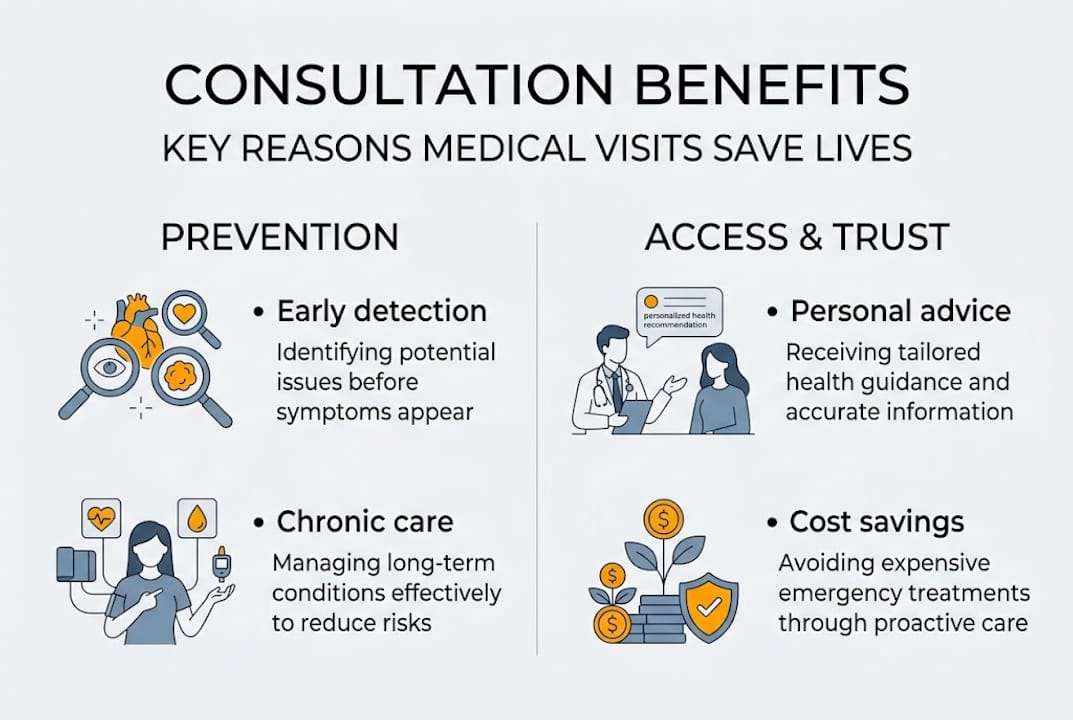
The expansion includes longer clinic hours, more appointment slots, and specialist teams that coordinate care across disciplines. Daily appointment numbers have risen by roughly 50%, reflecting growing patient trust and improved accessibility.
Advantages for international and local patients in Macau:
-
Access to specialists without long referral waits
-
Multidisciplinary teams for complex or chronic conditions
-
Elderly care programs with coordinated follow-up
-
Clinics equipped to serve non-Cantonese speaking patients
-
Outpatient settings that reduce exposure to hospital-acquired infections
| Metric | Detail |
|---|---|
| Specialty clinics | 52 active specialty outpatient clinics |
| Daily appointments | ~50% increase over previous years |
| MDT coverage | Complex, chronic, and elderly cases |
| Hospital load reduction | Significant decrease in unnecessary admissions |
| International patient access | Broad multilingual and specialist support |
This model matters for international patients because it demonstrates that Macau’s healthcare infrastructure is built for complexity, not just convenience. You can explore the full range of Macau outpatient services to understand what’s available across specialties.
The integration of telemedicine transformation into outpatient care has also expanded access for patients who need initial consultations or follow-ups without traveling. However, telemedicine works best as a complement to in-person care, not a replacement. The Macau medical center model reflects this balance, combining digital access with hands-on clinical assessment.
Statistic callout: A 50% rise in daily outpatient appointments signals more than system growth. It reflects a shift in how patients view preventive care: not as optional, but as essential.
Consultation length and access: One size does not fit all
Not every consultation fits the same mold. A healthy 30-year-old coming in for a routine checkup has very different needs than a 70-year-old managing three chronic conditions, or a patient discussing mental health concerns for the first time. Treating all consultations as equal creates inequity and risks missing critical information.
Fixed consultation times risk inequity for multimorbid patients, those with mental health needs, and patients who require interpreter services. Research shows that these groups consistently need more time to communicate effectively and receive accurate care.
| Patient group | Typical consultation need | Key consideration |
|---|---|---|
| Routine adult checkup | 10 to 15 minutes | Efficient and preventive |
| Elderly with multiple conditions | 20 to 30 minutes | Coordination across conditions |
| Mental health presentation | 30 to 45 minutes | Trust building and disclosure |
| Non-native language speaker | 20 to 30 minutes | Interpreter time and clarity |
| First-time international patient | 20 to 30 minutes | History, context, and orientation |
The takeaway here is practical. If you know your situation is complex, say so when booking. Ask for a longer appointment slot. A rushed consultation that misses half your concerns is not a consultation. It’s a missed opportunity.
Personalized, holistic care explained in context means your doctor considers your full picture: age, language, comorbidities (multiple simultaneous conditions), and emotional state. That level of attention is what separates a truly effective consultation from a box-checking exercise.
Pro Tip: When scheduling, tell the receptionist if you have multiple concerns or haven’t seen a doctor in over a year. This helps the clinic allocate the right amount of time and ensures you leave with real answers.
Rethinking consultations: Real outcomes beat convenience
There’s a growing temptation to replace doctor visits with health apps, online symptom checkers, or occasional telemedicine calls. The appeal is obvious: faster, cheaper, and available at midnight. But convenience has a ceiling when it comes to clinical accuracy.
Professional consultations with continuity consistently yield better outcomes than self-management or fragmented care. The data isn’t subtle about this. Patients with ongoing relationships with their doctors have lower mortality, fewer hospitalizations, and better management of chronic conditions.
What apps and symptom checkers can’t replicate is the clinical judgment that comes from knowing a patient over time. A doctor who has seen you annually for five years notices changes in your presentation that no algorithm would flag. That pattern recognition is irreplaceable.
We’ve seen patients at Globallmed arrive after months of self-managing a concern that turned out to be something far more serious. The delay didn’t save them time or money. It cost both. The medical wellness perspective we hold is straightforward: human connection in care is not a nice-to-have. It’s a clinical advantage. Convenience tools work best when they support a real consultation relationship, not substitute for one.
Explore expert outpatient consultation in Macau
You now have a clear picture of what medical consultations do, what’s at stake when you skip them, and how Macau’s outpatient system is built to support both local and international patients. The logical next step is acting on that knowledge.

At Globallmed clinic, we offer personalized outpatient consultations designed for patients who want proactive, high-quality care. Our multidisciplinary team is equipped to handle everything from routine checkups to complex chronic conditions. Browse our full outpatient services in Macau or learn more about our Macau medical center to find the right consultation for your needs. Booking is straightforward, and our team is ready to guide you through every step.
Frequently asked questions
What is the main benefit of regular medical consultations?
Continuity in care leads to lower mortality and hospital admissions, making regular consultations one of the most effective tools for long-term health protection. Early detection and consistent management are what make the difference.
Why do some people avoid seeing the doctor?
People often skip consultations because of cost, time pressure, distrust, or confidence in self-care, but avoiding medical care is linked to higher long-term costs and preventable emergencies. The short-term savings rarely hold up against the long-term consequences.
How does Macau’s outpatient care differ?
Macau offers 52 specialty clinics and multidisciplinary teams focused on chronic disease and elderly care, which meaningfully reduces the load on public hospitals. This makes specialist access faster and more coordinated than in many comparable healthcare systems.
Do all consultations take the same amount of time?
No. Consultation time needs to adapt to patient complexity, and patients with mental health concerns, multiple conditions, or language barriers typically require longer visits for accurate, effective care.