Pre-Travel Medical Consultation Explained for Medical Tourists

A pre-travel medical consultation is a specialized health evaluation that prepares international travelers for safe, informed journeys by identifying necessary vaccinations, destination-specific risks, and preventive health measures before departure. Known formally in travel medicine as a travel health consultation, this appointment is the single most effective tool for reducing health complications abroad. For medical tourists traveling to destinations like Macau for planned procedures, the stakes are even higher. A missed vaccination or unaddressed health risk can derail a treatment plan before it begins. This article breaks down exactly what happens during these consultations, when to schedule them, and why they are non-negotiable for anyone seeking healthcare overseas.
What is a pre-travel medical consultation?
A pre-travel medical consultation reviews your travel itinerary, health history, and vaccination records to produce tailored vaccine and preventive medicine recommendations specific to your trip. This is not a routine checkup. It is a risk-profiling appointment where a clinician maps your health baseline against the disease environment of your destination. The CDC, the Public Health Agency of Canada, and travel clinics worldwide treat this consultation as the foundation of any international travel health plan.
The distinction between a general checkup and a travel health consultation matters. A general practitioner reviews your current health. A travel medicine specialist or trained travel clinic clinician cross-references your health against destination-specific threats, including tropical diseases, water-borne pathogens, insect-borne illnesses, and regional vaccination requirements. For medical tourists, this dual lens is critical. You are not just visiting a country. You are entering a healthcare system, and your body needs to be prepared for both the environment and the procedure.
What to expect during a travel health consultation
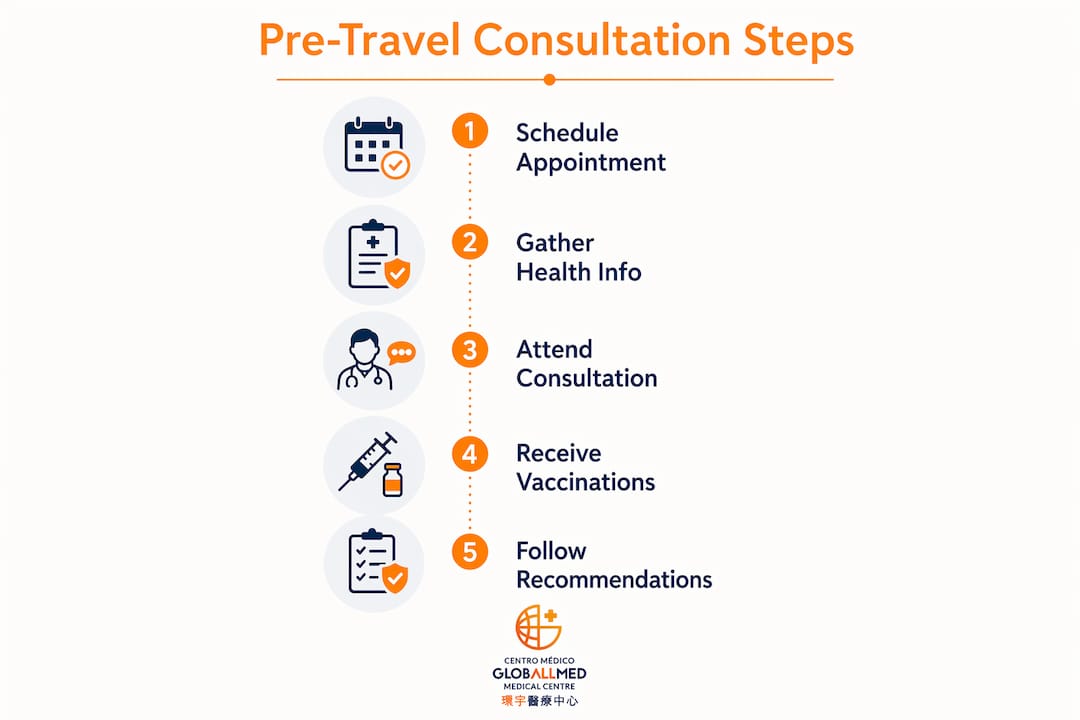
The appointment follows a structured sequence that covers your travel plans, your health profile, and your protection plan. Knowing what to bring and what to expect removes the guesswork and makes the consultation more productive.
What the clinician reviews:
- Your full travel itinerary, including all transit countries, not just your final destination
- Your complete medical history, current medications, and known allergies
- Your existing vaccination records and any gaps in routine adult immunizations
- Your planned activities, such as rural trekking, hospital visits, or extended stays
What the clinician recommends:
- Destination-specific vaccines and boosters based on current outbreak data
- Preventive medicines, including malaria prophylaxis and traveler’s diarrhea prescriptions
- Education on food and water safety, mosquito bite prevention, sun protection, and hygiene practices
- Guidance on managing chronic conditions or medications while abroad
What you need to bring:
Some travel health departments, including the Florida Department of Health in Citrus County, require specific documents such as a photo ID, your travel itinerary, your vaccination records, and in some cases the Yellow Book (the International Certificate of Vaccination). Consultation fees vary by provider, so confirm payment procedures when booking.
Pro Tip: Bring a printed or digital copy of your complete vaccination history, not just recent records. Clinicians need to see your full immunization timeline to identify gaps and avoid duplicate doses.
Understanding the consultation workflow before your appointment helps you ask better questions and leave with a complete protection plan rather than a partial one.

When should you schedule your pre-trip medical appointment?
Timing is the most underestimated variable in pre-travel health planning. The Public Health Agency of Canada advises scheduling 4 to 6 weeks before departure, with 6 to 8 weeks being the preferred window. That gap exists for a specific reason: many vaccines require multiple doses spread over weeks, and your immune system needs time to build protection after each dose.
Here is why the timeline matters in practice:
- Hepatitis A and B series: The full hepatitis B series spans six months. Even an accelerated schedule requires at least three doses over three to four weeks to generate meaningful immunity.
- Yellow fever: A single dose provides lifelong protection, but it must be administered at a certified yellow fever vaccination center, and the certificate is only valid 10 days after the injection.
- Typhoid: The oral typhoid vaccine requires four doses taken every other day over a week, followed by a one-week wait before full protection is active.
- Malaria prophylaxis: Some antimalarial medications, such as doxycycline, must be started one to two days before entering a malaria zone. Others, like mefloquine, require a two-week lead time.
What if your trip is imminent?
Accelerated vaccine schedules allow clinicians to compress multi-dose timelines and prioritize the highest-impact vaccines when time is short. Partial immunity is significantly better than none. Even a consultation booked 48 hours before departure can yield meaningful protection through rapid-schedule vaccines and same-day prescriptions for preventive medicines.
Pro Tip: If you are planning medical tourism and your procedure date is fixed, count backward from your departure date and book your travel health consultation the same week you book your flights. Waiting until the week before departure is the single most common mistake medical tourists make.
Key vaccinations and preventive medicines for international travelers
Travel vaccination recommendations vary by destination, traveler health status, and planned activities. The table below outlines the most commonly discussed vaccines and medicines during a travel health consultation.
| Vaccine or Medicine | Primary Use | Timing Before Travel |
|---|---|---|
| Hepatitis A | Food and water-borne liver infection | 2 to 4 weeks minimum; full series for long-term protection |
| Typhoid | Contaminated food and water in high-risk regions | 1 to 2 weeks before departure |
| Yellow fever | Required for entry to many African and South American countries | At least 10 days before travel |
| Malaria prophylaxis | Mosquito-borne disease prevention in tropical zones | Varies by drug: 1 day to 2 weeks before entry |
| Hepatitis B | Blood and body fluid exposure, relevant for medical tourists | Full series over 6 months; accelerated over 3 to 4 weeks |
| Tdap booster | Routine adult immunization update | Any time; often identified as a gap during consultation |
The hepatitis B entry deserves specific attention for medical tourists. Anyone undergoing a surgical procedure, dental treatment, or any intervention involving blood exposure abroad faces a direct hepatitis B risk. Routine adult vaccines like Tdap are also reviewed during the consultation, filling gaps that travelers would not otherwise address. This is one of the most overlooked benefits of the appointment: it catches missed boosters that have nothing to do with travel but everything to do with your overall health.
Clinicians also prescribe preventive medicines beyond vaccines, including antibiotics for traveler’s diarrhea and antimalarials tailored to your destination’s drug-resistance profile. A traveler heading to Southeast Asia may receive a different antimalarial than one heading to sub-Saharan Africa, because resistance patterns differ by region. Personalized prescribing is a core function of the consultation, not an add-on.
Reviewing your preventive medicine protocols before your appointment helps you understand which prescriptions to ask about and why.
How pre-travel consultations protect medical tourists specifically
Medical tourists face a layered set of health risks that leisure travelers do not. They are entering a foreign healthcare environment, often undergoing procedures that carry post-operative infection risks, and then returning home through airports and transit hubs while potentially immunocompromised. A pre-travel consultation addresses each of these layers directly.
The specific benefits for medical tourists include:
- Destination risk mapping: The consultation identifies destination-specific healthcare risks and recommends targeted mitigation, including which pathogens are endemic in the region where your procedure will take place.
- Pre-procedure vaccination coverage: Vaccines like hepatitis B directly reduce the risk of blood-borne infection during surgical or dental procedures abroad.
- Informed communication with foreign providers: A clinician who reviews your health history before travel can prepare a medical summary you bring to your overseas provider, reducing the risk of contraindicated treatments or missed allergies.
- Compliance with local health requirements: Some countries require proof of specific vaccinations for entry or for admission to healthcare facilities. A travel health consultation identifies these requirements before you arrive at the border.
- Post-procedure risk reduction: Travelers returning home after a procedure need guidance on wound care, infection monitoring, and when to seek follow-up care. Many travel clinics provide this as part of the consultation package.
Understanding why medical standards matter when seeking care abroad reinforces why the pre-travel consultation is the first step, not an optional one.
Key takeaways
A pre-travel medical consultation is the most effective single action an international traveler or medical tourist can take to reduce health risks before departure.
| Point | Details |
|---|---|
| Schedule early | Book your consultation 6 to 8 weeks before departure to complete multi-dose vaccine series on time. |
| Bring full records | Bring your complete vaccination history, travel itinerary, and photo ID to every appointment. |
| Vaccines are personalized | Recommendations are tailored to your destination, health status, and planned activities, not a standard list. |
| Medical tourists face extra risk | Hepatitis B and pre-procedure vaccinations directly reduce infection risk during overseas treatments. |
| Last-minute options exist | Accelerated vaccine schedules provide partial immunity even when travel is days away. |
Why most travelers underestimate this appointment
Most travelers I have spoken with treat the pre-travel consultation as a box to check, a quick stop to get a shot or two before boarding. That framing misses the point entirely. The real value of the appointment is the risk conversation, not the injection.
The travelers who get the most from these consultations come in with their itinerary printed, their questions written down, and a clear understanding of what procedures or activities they are planning abroad. They leave with a personalized health plan, not just a vaccination card. The ones who skip the consultation or book it the day before departure often discover gaps in their protection only after they are already abroad, when options are limited and costs are higher.
One pattern I see repeatedly with medical tourists is the assumption that the overseas clinic will handle everything. Foreign providers are responsible for the procedure. They are not responsible for your baseline immunization status or your pre-existing health risks. That responsibility sits with you and your pre-travel clinician. The consultation is where you close that gap.
The other thing most travelers miss is the routine immunization review. A travel health consultation is one of the few moments in adult healthcare where someone systematically checks whether your Tdap, MMR, or other standard boosters are current. Many adults are years overdue on these vaccines and would never know without this appointment.
— IGHS
Plan your pre-travel consultation at GLOBALLMED Medical Center

GLOBALLMED Medical Center in Macau offers pre-travel consultations through its outpatient clinic, staffed by clinicians experienced in travel medicine and international patient care. Whether you are traveling to Macau for a planned procedure or departing from Macau to seek treatment elsewhere, the team provides personalized vaccination planning, preventive medicine prescriptions, and destination-specific health advice tailored to your itinerary and health profile. GLOBALLMED’s full range of services is designed to meet international standards, making it a trusted first stop for medical tourists who need expert pre-trip medical advice before crossing borders.
FAQ
What is a travel health consultation?
A travel health consultation is a medical appointment that reviews your travel itinerary, vaccination history, and health profile to recommend destination-specific vaccines and preventive medicines. It is distinct from a routine checkup because it focuses on risks tied to your specific destination and activities.
How far in advance should I book a pre-travel medical checkup?
Health authorities including the Public Health Agency of Canada recommend booking 6 to 8 weeks before departure. This window allows time to complete multi-dose vaccine series and for your immune system to build full protection before you travel.
Do medical tourists need a pre-travel consultation?
Medical tourists need a pre-travel consultation more than leisure travelers do. Procedures abroad carry direct exposure risks, such as hepatitis B from blood contact, and foreign healthcare providers are not responsible for your baseline immunization status.
What vaccines are most important for medical tourists?
Hepatitis B is the most directly relevant vaccine for anyone undergoing a surgical or dental procedure abroad. Hepatitis A, typhoid, and destination-specific vaccines like yellow fever are also commonly recommended, depending on where you are traveling.
Can I still get a consultation if I am traveling soon?
A consultation is worth attending even with 48 hours’ notice. Clinicians use accelerated vaccine schedules to prioritize the highest-impact vaccines and can prescribe same-day preventive medicines like malaria prophylaxis and traveler’s diarrhea antibiotics.