
Outpatient Travel Healthcare: What Patients Need to Know

Outpatient travel healthcare is defined as the delivery of medical services by traveling healthcare professionals in clinic-based settings, where patients receive treatment without formal hospital admission. The industry-standard term for this staffing model is “travel healthcare,” and it operates through short-term contracts, typically 13 weeks in length, placing licensed clinicians in outpatient facilities that need temporary coverage. Observation status can last 24–48 hours and still qualify as outpatient care, which defines the upper boundary of this care category. GLOBALLMED Medical Center in Macau represents this model in practice, providing international patients with access to outpatient healthcare services across multiple clinical specialties without requiring hospital admission.
What is outpatient travel healthcare and how does it work?
Outpatient travel healthcare covers two connected realities: patients who seek medical care while traveling abroad, and healthcare professionals who take short-term clinical assignments at outpatient facilities away from their home base. Both groups interact within the same system, and understanding how that system is structured helps patients make better decisions about where and how to receive care.

For patients, outpatient care means receiving diagnostics, treatments, minor surgeries, and specialist consultations without being formally admitted to a hospital. The patient arrives, receives care, and returns home the same day. This model covers a broad range of services, from routine checkups and imaging to chronic disease management and preventative screenings.
For healthcare professionals, travel healthcare explained simply is this: a clinician accepts a contract at a facility outside their home region, works a defined assignment, and then moves to the next placement. Short-term contracts averaging 13 weeks are the standard in 2026. This staffing model fills gaps caused by seasonal surges, staff leave, and rural shortages, benefiting both facilities and patients who need consistent access to specialists.
The two perspectives converge at the point of care. A patient traveling internationally for orthopedic consultation or a wellness checkup benefits directly from the presence of experienced traveling clinicians who staff outpatient facilities to international standards.
What settings and clinical specialties are involved?
Outpatient travel healthcare roles are concentrated in clinics, urgent care centers, diagnostic imaging facilities, and specialty practice environments. These settings differ significantly from inpatient hospital wards in terms of patient flow, acuity, and scheduling predictability.
The table below outlines the most common outpatient settings and the clinical specialties typically associated with each.
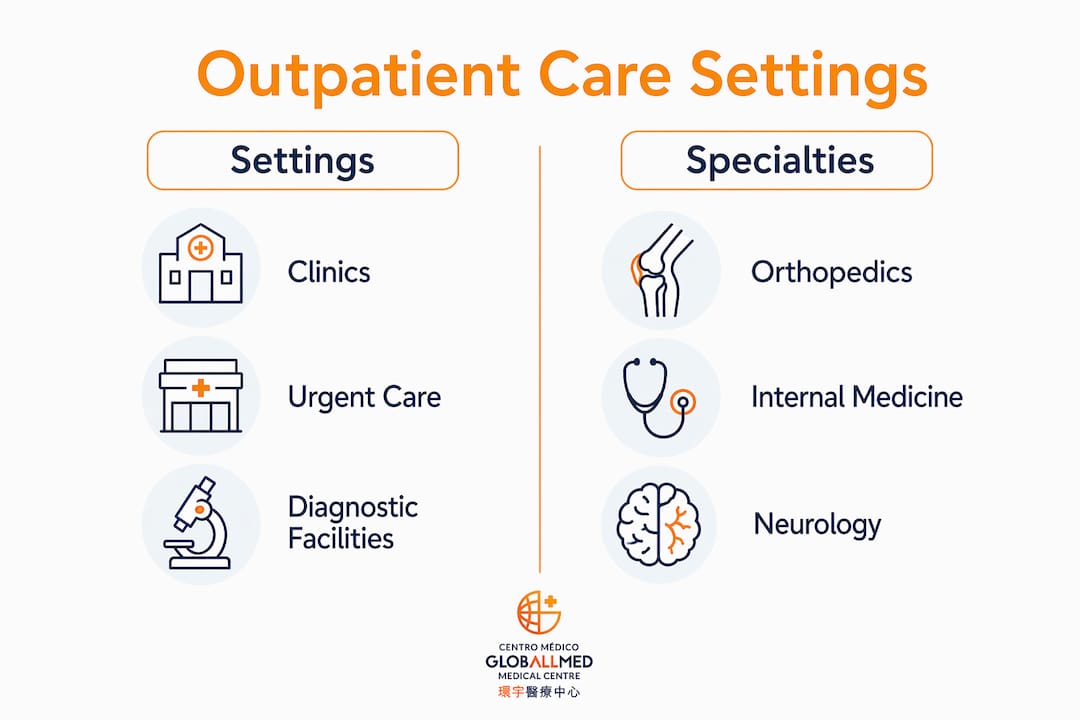
| Outpatient Setting | Common Specialties |
|---|---|
| General outpatient clinic | Internal medicine, family medicine, preventative care |
| Specialty clinic | Orthopedics, neurology, sports medicine |
| Diagnostic center | Radiology, laboratory medicine, pathology |
| Urgent care center | Emergency medicine, wound care, acute illness |
| Pediatric clinic | Pediatrics, developmental medicine, vaccinations |
| Women’s health clinic | Gynecology, obstetrics, reproductive health |
Patient flow in outpatient settings follows a scheduled, appointment-driven model. This contrasts with inpatient care, where patient acuity and census fluctuate unpredictably. For patients traveling internationally, this predictability translates into reliable appointment scheduling and defined consultation times. For clinicians, it means a more consistent daily structure than hospital floor work typically provides.
Specialty areas like orthopedics, sports medicine, and neurology are particularly well-suited to the outpatient travel model. These disciplines rely on planned consultations, imaging reviews, and follow-up appointments rather than emergency interventions. Preventative care and chronic disease management also fit naturally into this framework, since both require structured, recurring visits rather than acute hospital stays.
Pro Tip: When researching outpatient clinics abroad, confirm that the facility operates under a scheduled appointment system rather than a walk-in model. Scheduled systems indicate organized patient flow and reduce wait times for international patients.
How do contracts and logistics work in outpatient travel healthcare?
Contract structure is the operational backbone of travel healthcare explained from the professional side. The 13-week assignment is the industry standard, though contracts can run shorter for urgent coverage needs or longer for extended specialty placements. Professionals should treat every contract as a legally binding document and review all terms before signing.
Key contract elements to clarify before accepting any outpatient travel assignment include:
- Shift schedule: Confirm the number of hours per week, shift start and end times, and whether weekend coverage is required.
- Floating policy: Understand whether the contract permits reassignment to other departments or facilities. Floating policies are a common source of disputes when not addressed in writing.
- Pay package breakdown: Separate the base hourly rate from tax-free stipends for housing and meals. These are distinct components with different tax implications.
- Documentation requirements: Clarify the electronic health record system in use and whether orientation time is included in the contract hours.
- Cancellation terms: Know the notice period required by both parties and whether the facility can cancel shifts without compensation.
Pro Tip: Maintaining a tax home is the single most important financial step for travel healthcare professionals. A legitimate permanent residence qualifies you for tax-free housing and meal stipends, which can substantially increase your net take-home pay compared to a permanent staff position.
Patients seeking outpatient care abroad face a parallel set of logistical considerations. Scheduling an appointment in advance, confirming that the facility accepts international patients, and understanding what documentation to bring are all steps that determine whether the visit proceeds smoothly. Facilities that operate under international standards, such as GLOBALLMED Medical Center, typically provide pre-visit guidance to help international patients prepare.
What are the benefits and challenges of outpatient travel healthcare?
Outpatient travel healthcare offers distinct advantages for both professionals and patients, but it also carries specific challenges that require preparation.
Benefits for healthcare professionals
Outpatient settings attract clinicians who prefer specialty clinical work with predictable hours over the variable demands of inpatient hospital shifts. The financial structure of travel contracts adds to this appeal. Tax-free stipends for housing and meals, combined with competitive base rates, often result in higher net compensation than permanent staff roles at comparable facilities.
Key professional benefits include:
- Diverse clinical exposure across multiple facility types and patient populations
- Consistent scheduling that supports work-life balance
- Opportunities to build expertise in a specific specialty across different clinical environments
- Financial advantages through tax-optimized pay packages
Challenges professionals face
Adapting to new electronic health record systems at each assignment takes time. Facility-specific policies, documentation standards, and team dynamics all require adjustment. Floating demands, when not clearly defined in the contract, can place clinicians in departments outside their specialty without additional compensation. Asking detailed questions during the interview phase about workload, double-booking policies, and mentorship availability reduces these risks significantly.
Pro Tip: Review common outpatient concerns before your first assignment. Understanding the typical friction points in outpatient travel roles helps you ask the right questions before signing.
How does outpatient travel healthcare work for patients seeking care abroad?
Patients who travel internationally for medical care operate within the outpatient model when their treatment does not require hospital admission. Outpatient services include diagnostics, minor surgical procedures, specialist consultations, and chronic disease management, all delivered without an inpatient stay. This makes outpatient medical travel accessible for a wide range of conditions that do not require overnight hospitalization.
Patients considering outpatient care abroad should address the following before traveling:
- Scheduling and referrals: Confirm appointment availability and whether a referral from a home-country physician is required by the destination facility.
- Medical records: Bring complete records, including imaging, lab results, and medication lists, in a format the receiving clinic can access.
- Language and communication: Verify that the facility provides consultations in your language or offers interpreter services.
- Continuity of care: Plan for follow-up care after travel to ensure that treatment results and recommendations are communicated back to your primary care provider.
- Insurance coverage: Confirm whether your travel health insurance covers outpatient services at the destination facility, including diagnostics and specialist fees.
Quality assurance is the central concern for patients choosing outpatient care internationally. Facilities that operate under recognized international standards provide a measurable baseline for clinical quality. GLOBALLMED Medical Center addresses this directly by maintaining a qualified clinical team, operating under Macau’s regulatory framework, and offering a broad range of outpatient healthcare services designed to meet international patient expectations across medical, wellness, and specialty departments.
Key Takeaways
Outpatient travel healthcare delivers medical services without hospital admission, through short-term staffing contracts and internationally accessible clinic-based care that serves both traveling professionals and patients seeking treatment abroad.
| Point | Details |
|---|---|
| Core definition | Outpatient care means treatment without formal hospital admission, including same-day and observation stays up to 48 hours. |
| Standard contract length | Travel healthcare professionals typically work 13-week assignments, with variations based on facility need. |
| Contract clarity | Floating policies, shift schedules, and pay breakdowns must be confirmed in writing before signing any assignment. |
| Tax home advantage | Maintaining a permanent residence qualifies travel professionals for tax-free housing and meal stipends. |
| Patient logistics | International patients should confirm scheduling, insurance coverage, and continuity of care before traveling for outpatient treatment. |
The case for getting outpatient travel healthcare right from the start
The most consistent mistake I see in outpatient travel healthcare is treating it as a simple transaction. Professionals sign contracts without reading the floating clauses. Patients book appointments without confirming what their insurance actually covers abroad. Both groups pay for those oversights.
What makes outpatient travel healthcare work well is specificity. For professionals, that means asking exact questions during the interview: How many patients per day? Is double-booking standard practice? What is the documentation expectation per visit? Vague answers at that stage predict difficult assignments. For patients, it means treating the pre-visit checklist as seriously as the appointment itself. A facility that cannot answer basic questions about scheduling, language support, and record transfer is not ready to serve international patients.
The outpatient model has a structural advantage that is often underestimated. Scheduled patient flow, specialty-focused environments, and defined consultation times create conditions where quality care is reproducible. That reproducibility is what international patients are actually buying when they choose a private outpatient clinic abroad. GLOBALLMED Medical Center operates on exactly this principle: organized, specialty-driven care delivered to patients who expect consistency and clinical competence regardless of where they live.
The professionals who thrive in outpatient travel roles are the ones who treat each assignment as a clinical and logistical project. They read the contract, ask the hard questions, and maintain their tax home. The patients who benefit most are the ones who plan the visit as carefully as they plan the trip.
— IGHS
GLOBALLMED Medical Center’s outpatient services for international patients
GLOBALLMED Medical Center is Macau’s largest private outpatient clinic, structured to serve both local residents and international patients seeking high-quality medical care without hospital admission.

The center’s departments cover the full range of outpatient healthcare services, including the medical clinic department, beauty, wellness, and wellbeing, and women’s and children’s health checkups. Each department operates under international clinical standards with a qualified medical team. International patients can review the full list of available outpatient services and book appointments directly through the center’s online platform. For specific inquiries, the contacts page provides direct access to the GLOBALLMED Medical Center team.
FAQ
What is the difference between outpatient and inpatient care?
Outpatient care means the patient receives treatment and returns home the same day, without formal hospital admission. Inpatient care requires an overnight stay or longer under hospital supervision.
How long do outpatient travel healthcare contracts typically last?
The standard contract length in travel healthcare is 13 weeks, though shorter and longer assignments exist depending on facility needs and specialty demand.
Can patients receive specialist care at outpatient clinics abroad?
Patients can access a wide range of specialist services at outpatient clinics internationally, including orthopedics, neurology, diagnostics, and preventative care, without requiring hospital admission.
What should patients bring to an outpatient appointment abroad?
Patients should bring complete medical records, current medication lists, imaging results, and proof of insurance coverage to any international outpatient appointment.
Does travel health insurance cover outpatient services?
Coverage varies by policy. Patients should confirm with their insurer whether outpatient consultations, diagnostics, and specialist fees at the destination facility are included before traveling.