
Role of Pharmacist in Outpatient Setting Explained

The role of pharmacist in outpatient setting is defined as the direct provision of medication management, patient counseling, and clinical support services to patients who receive care without hospital admission. Outpatient pharmacists do far more than fill prescriptions. They conduct Medication Therapy Management (MTM), operate under collaborative practice agreements (CPAs), manage chronic disease therapies, and serve as the last clinical checkpoint before a patient takes a medication home. For healthcare professionals, patients, and caregivers alike, understanding these pharmacist duties in outpatient care is the foundation of safer, more effective treatment.
What are the primary duties of outpatient pharmacists?
Outpatient pharmacy services cover prescription filling and verification, comprehensive medication reviews, patient education, immunizations, compounding, and MTM. UCSF Health, for example, offers free medication delivery, bedside delivery at discharge, and specialized pediatric dosing compounding as standard outpatient pharmacy functions. These services reflect how far the pharmacist’s role has expanded beyond the dispensing counter.
The core clinical duties break down into four categories:
- Prescription verification and dispensing: Pharmacists check every prescription for accuracy, drug interactions, contraindications, and appropriate dosing before a medication reaches the patient.
- Medication Therapy Management (MTM): MTM services involve ongoing monitoring, education, and adjustment support to optimize patient outcomes, particularly for patients managing multiple chronic conditions.
- Patient counseling: Pharmacists explain how to take medications correctly, what side effects to watch for, and how to maintain adherence over the long term.
- Immunizations and preventive care: Many outpatient pharmacists administer vaccines and screen for preventable conditions, extending the reach of primary care.
- Compounding: For patients who need customized formulations, such as pediatric liquid doses or allergen-free preparations, outpatient pharmacists compound medications to specification.
Pro Tip: If you manage a patient with polypharmacy, request a formal MTM session with the outpatient pharmacist. A single structured review can identify redundant therapies, dangerous interactions, and adherence barriers that a routine appointment may miss.
The scope of these duties positions outpatient pharmacists as clinical partners, not just dispensers. When a pharmacist catches a contraindicated drug combination before the patient leaves the clinic, that intervention can prevent an emergency department visit entirely.

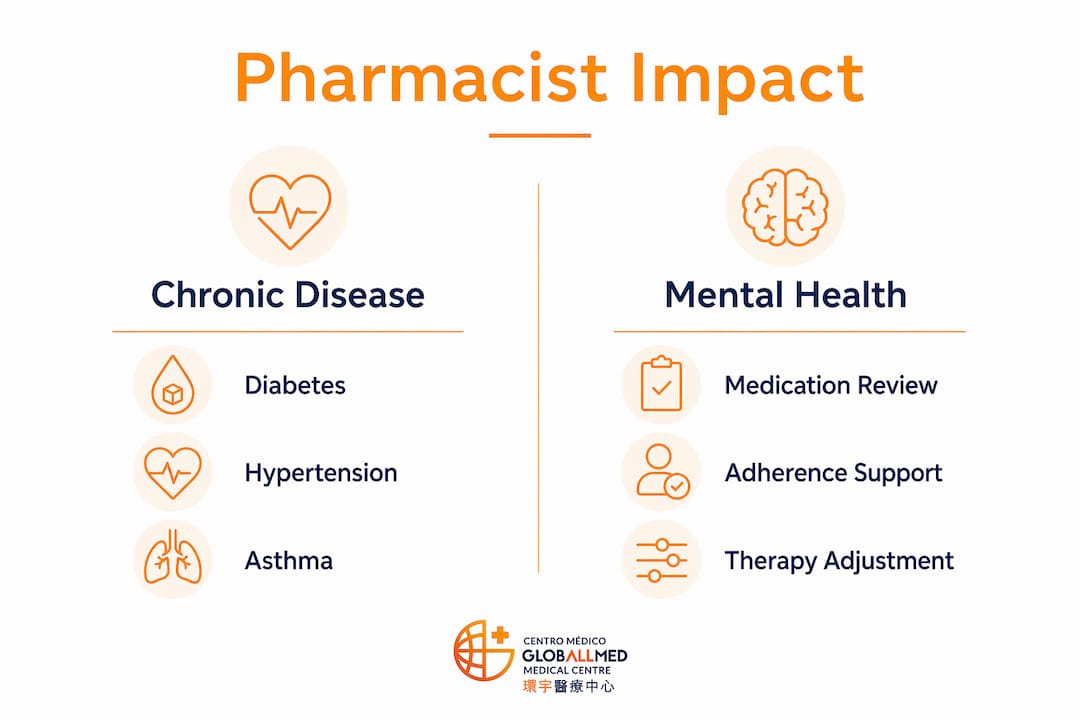
How do outpatient pharmacists impact chronic disease and mental health care?
Pharmacist involvement in chronic disease management produces measurable improvements in medication adherence and symptom control. A systematic review of 23 studies confirmed improvements across medication adherence and patient-reported outcomes in outpatient mental health settings. That finding matters because mental health medications are among the most frequently discontinued therapies, often due to side effects or misunderstanding of the treatment timeline.
Outpatient pharmacists manage therapy for conditions including:
- Diabetes: Adjusting insulin regimens, counseling on blood glucose monitoring, and identifying drug-nutrient interactions.
- Hypertension: Reviewing antihypertensive combinations, addressing adherence barriers, and flagging white-coat effect versus true treatment resistance.
- Asthma and COPD: Demonstrating inhaler technique, reviewing rescue versus maintenance therapy use, and coordinating with pulmonologists.
- Mental health conditions: Supporting antidepressant, antipsychotic, and mood stabilizer therapy with education on onset timelines and side effect management.
Pharmacists working under collaborative practice agreements can initiate, modify, or discontinue medications based on patient assessments without requiring a separate physician visit for each change. This authority is not a workaround. It is a clinically validated model that shortens the time between identifying a problem and correcting it.
| Condition | Pharmacist intervention | Patient benefit |
|---|---|---|
| Type 2 diabetes | Insulin titration, adherence counseling | Improved HbA1c control |
| Hypertension | Antihypertensive review, lifestyle coaching | Reduced cardiovascular risk |
| Depression | Antidepressant education, side effect monitoring | Higher treatment completion rates |
| Asthma/COPD | Inhaler technique training, regimen review | Fewer exacerbations and ER visits |
Pharmacists also apply specialized knowledge in pharmacokinetics and pharmacodynamics to individualize therapy in ways that a general practitioner, managing dozens of conditions simultaneously, may not have time to address. That depth of drug knowledge is the pharmacist’s core clinical asset.
What roles do pharmacists play in transitions of care and medication safety?
Transitions of care represent one of the highest-risk moments in a patient’s treatment journey. Pharmacist-led interventions at admission and discharge, including medication reconciliation and counseling, reduce adverse drug events and hospital readmissions. The mechanism is straightforward: errors multiply when medication lists are transferred between care settings without a trained reviewer.
The outpatient pharmacist’s role in transitions of care follows a clear sequence:
- Admission medication reconciliation: The pharmacist compiles a complete and accurate medication list by cross-referencing the patient’s self-report, pharmacy records, and the electronic health record (EHR).
- Inpatient therapy monitoring: For hospital-based outpatient pharmacies, pharmacists flag drug interactions and dosing errors during the patient’s stay.
- Discharge counseling: Before the patient leaves, the pharmacist reviews every new or changed medication, explains the purpose, and addresses questions directly.
- Bedside and discharge delivery: Bedside delivery services provide medications to patients before they leave the hospital, eliminating the gap between discharge and first dose.
- Post-discharge follow-up: Phone calls or telehealth check-ins within 72 hours of discharge confirm adherence and catch early signs of adverse reactions.
A critical advantage of hospital-based outpatient pharmacies is direct EHR access, which enables pharmacists to detect potential interactions and errors more effectively than retail pharmacies operating from incomplete medication histories. Most patients are unaware this distinction exists, yet it has direct implications for their safety.
Pro Tip: When a family member is discharged from the hospital, ask the outpatient pharmacist specifically about any medications that were stopped during the stay. Discontinued drugs are a leading source of post-discharge confusion and unintentional non-adherence.
How does pharmacist integration into outpatient teams benefit providers and patients?
Pharmacists embedded as interdisciplinary team members improve provider efficiency and reduce physician burnout by absorbing the medication complexity that consumes a disproportionate share of clinical time. Providers in primary care accountable care organizations (ACOs) highlight pharmacists’ role in offloading that complexity, particularly for patients on five or more medications. A physician freed from reviewing drug interaction databases can focus on diagnosis and patient relationships.
The contrast between embedded and disconnected pharmacist models is significant:
| Model | Provider experience | Patient experience |
|---|---|---|
| Embedded pharmacist | Direct team communication, shared EHR, real-time consultation | Faster medication decisions, fewer delays |
| Disconnected pharmacist | Referral-based, delayed communication, fragmented records | Slower resolution of medication issues |
A qualitative study with patients and clinicians confirmed that pharmacist integration improves teamwork and patient outcomes, while also noting that oversight barriers and communication gaps remain challenges when pharmacists are not fully embedded. The solution is structural. Pharmacists need shared records, physical proximity to clinical teams, and defined authority to act on what they find.
Successful integration also depends on adapting to individual provider workflows rather than applying a generic model. A pharmacist who understands how a specific cardiologist communicates and what level of autonomy they prefer will contribute more effectively than one operating from a standardized protocol that ignores team dynamics. This is the difference between a pharmacist who is tolerated and one who is sought out.
Effective pharmacist integration is strongest when pharmacists are embedded in patient-centered teams rather than functioning as separate services, reducing outdated hierarchies that slow care delivery. The impact of pharmacists in outpatient settings scales directly with how well they are woven into the clinical fabric of the team.
Key takeaways
The role of pharmacist in outpatient setting is most effective when pharmacists are embedded in interdisciplinary teams with EHR access, CPA authority, and direct patient contact across the full care continuum.
| Point | Details |
|---|---|
| Core duties extend beyond dispensing | Outpatient pharmacists provide MTM, counseling, immunizations, and compounding as standard services. |
| Chronic disease impact is evidence-based | A review of 23 studies confirms pharmacist involvement improves adherence and outcomes in mental health and chronic illness. |
| Transitions of care reduce readmissions | Medication reconciliation and discharge counseling by pharmacists lower adverse drug events and hospital returns. |
| Embedded models outperform disconnected ones | Pharmacists with shared EHR access and team proximity deliver faster, safer medication decisions. |
| CPAs expand clinical authority | Collaborative practice agreements allow pharmacists to initiate or adjust therapies without a separate physician visit. |
Why the outpatient pharmacist’s role is still underestimated
Most patients think of a pharmacist as the person who hands them a bag at the counter. Most physicians think of them as a resource to call when something goes wrong. Both views are outdated, and both cost patients better care.
What I have seen consistently is that the pharmacist’s value is highest in the moments no one plans for: the patient who quietly stops taking a blood pressure medication because of a side effect they were too embarrassed to mention to their doctor, the caregiver who misreads a discharge instruction and doubles a dose, the elderly patient on eleven medications whose new prescription creates an interaction that no single prescriber noticed because each one only sees their own piece of the list. The outpatient pharmacist is the only clinician positioned to see all of it at once.
The future of this role runs through telepharmacy and expanded CPAs. Telepharmacy is already extending pharmacist reach to patients in rural and underserved areas who would otherwise receive no medication counseling at all. Expanded CPAs are allowing pharmacists in progressive health systems to manage entire chronic disease panels independently. Neither trend is speculative. Both are happening now.
The uncomfortable truth is that health systems which treat pharmacy as a support function rather than a clinical function are leaving measurable patient outcomes on the table. The evidence is not ambiguous. The question is whether administrators and providers are willing to restructure workflows to reflect what the data already shows.
— IGHS
Outpatient pharmacy services at GLOBALLMED Medical Center

GLOBALLMED Medical Center integrates pharmacy expertise directly into its outpatient clinical model at its Macau facility. Patients receive medication counseling, chronic disease therapy support, and medication reviews as part of their standard care, not as an add-on service. Whether you are managing a long-term condition, navigating a new prescription, or preparing for discharge, GLOBALLMED’s clinical team coordinates pharmacy care with your treating physician to keep your therapy on track. Explore the full range of outpatient clinic services at GLOBALLMED Medical Center and book a consultation with a specialist who treats medication management as a clinical priority, not an afterthought.
FAQ
What is the role of pharmacist in outpatient setting?
The role of pharmacist in outpatient setting covers prescription verification, MTM, patient counseling, immunizations, and medication reconciliation for patients who do not require hospital admission. Outpatient pharmacists also operate under collaborative practice agreements that allow them to adjust therapies based on clinical assessments.
How do pharmacists help with chronic disease management?
Pharmacists apply specialized knowledge in pharmacokinetics and pharmacodynamics to manage medications for diabetes, hypertension, asthma, COPD, and mental health conditions. A systematic review of 23 studies confirms that pharmacist involvement improves medication adherence and patient-reported outcomes in outpatient chronic disease care.
What is Medication Therapy Management (MTM)?
MTM is a structured service in which pharmacists conduct ongoing monitoring, education, and therapy adjustment support to optimize outcomes for patients on complex medication regimens. It is particularly effective for patients managing multiple chronic conditions simultaneously.
How do outpatient pharmacists reduce hospital readmissions?
Pharmacists reduce readmissions through medication reconciliation at admission and discharge, bedside medication delivery, and post-discharge follow-up calls that confirm adherence and catch adverse reactions early. Direct EHR access in hospital-based outpatient pharmacies makes this reconciliation more accurate than retail pharmacy alternatives.
What is a collaborative practice agreement (CPA)?
A CPA is a formal arrangement between a pharmacist and a physician that authorizes the pharmacist to initiate, modify, or discontinue medications within a defined scope without requiring a separate physician order for each change. CPAs are a key mechanism for expanding the clinical impact of pharmacists in outpatient settings.