
Prepare a Symptoms List for a Specialist Visit

Create a one-page symptom summary and a short timeline before you walk into any specialist’s office. That single document, built in advance, does more to shape the outcome of your appointment than almost anything else in your control.
Here is a sample entry you can copy and adapt: “Intermittent left knee pain, started March 2026, worse after climbing stairs, 4/10 at rest, 7/10 with stairs, NSAIDs give partial relief.” One sentence, five data points, zero wasted time.
Every specialist wants the same core elements from you, regardless of the body system involved:
- Onset (when it started, sudden or gradual)
- Pattern (constant, intermittent, or triggered)
- Severity on a 0 to 10 scale
- What makes it worse and what helps
- Any treatments already tried
Pro Tip: Write your summary before you feel rushed. Most people draft a sharper, more accurate account sitting at their kitchen table the night before than they do in a waiting room five minutes before being called back.
Key Takeaways
A specialist visit runs more efficiently when the patient arrives with a one-page symptom summary, a short timeline, and three ranked questions instead of an open-ended history.
| Point | Details |
|---|---|
| Build a one-page summary | Include your main concern, symptom details, medications, allergies, and top three questions. |
| Use a symptom timeline | Track date, severity (0 to 10), triggers, and what helped rather than writing a long narrative. |
| Confirm records arrived | Call ahead to check whether referrals, labs, and imaging reached the specialist’s office. |
| Lead with your goal | State your main concern first, then use the Ask Me 3 questions before leaving. |
| Follow up in writing | Update your summary with new medications, tests, and next steps right after the visit. |
Authoritative Resources and GLOBALLMED Medical Center Templates
- MedlinePlus offers checklists covering symptoms, medical history, and medications to bring to any visit.
- The National Institute on Aging (NIH) provides guidance on prioritizing concerns and requesting written materials.
- AHRQ’s patient engagement resources outline the Ask Me 3 question framework.
- GLOBALLMED Medical Center’s common specialist consultation questions list offers ready-made question templates.
Table of Contents
- How to Prepare Symptoms List for a Specialist Visit
- What Details Should a Symptoms Checklist for Doctor Visits Include?
- How to Organize a Specialist Visit Symptom Timeline
- What to Bring to a Specialist Visit
- How to Communicate Symptoms Clearly During the Appointment
- After the Visit: Follow-Up and When to Call
- What Phrasing Gets a Specialist’s Attention Fastest?
- Book Your Specialist Visit With a Clear Plan in Hand
- Frequently Asked Questions
How to Prepare Symptoms List for a Specialist Visit
Preparing for a specialist appointment works best on a schedule, not in a last-minute scramble the morning of your visit.
One week before: Confirm your referral was received. Call the referring clinician’s office or the specialist’s front desk and ask directly whether your records, imaging, and lab results have arrived. Specialists often review your file before you walk in, so gaps here cost real time.
Three days before: Draft your one-page summary and timeline. List every medication, dose, and supplement you currently take.
Day before: Reread your summary and pick your top three questions. Research from patient-education resources notes that many specialist visits tend to be brief, so a long question list guarantees most of it goes unanswered. Rank by urgency and ask the most important one first.
Arrival: Bring printed or digital copies of everything, plus a photo ID and insurance card.
To prioritize concerns, ask yourself which symptom most affects your daily function, which one is new or worsening, and which one you are most afraid of. Those three questions should top your list, not whichever one you thought of last.

Pro Tip: Hand your one-page summary to the specialist before they ask a single question. It reframes the visit from “tell me your history” to “confirm my understanding,” which is a faster conversation.
For a reusable template covering this exact preparation window, GLOBALLMED Medical Center’s specialist consultation preparation checklist walks through each step in more depth.
What Details Should a Symptoms Checklist for Doctor Visits Include?
A symptoms checklist for doctor visits needs specific fields, not a narrative. Specialists are trained to extract clinical patterns from structured data, and a story format buries the pattern.
For each symptom, record:
- Onset: exact date if sudden, or approximate month if gradual
- Timing and frequency: constant, daily, weekly, or tied to specific activities
- Location: precise body area, and whether it moves or stays fixed
- Severity: rate it 0 to 10 at rest and during flare-ups
- Duration: how long each episode lasts
- Triggers and relief: what makes it worse, what makes it better, and by how much
- Associated symptoms: anything that shows up alongside the main complaint
- Recent changes: has frequency, intensity, or character shifted in the last month
Prior treatments deserve their own line for each attempt: what you tried, the dose, how long you used it, any side effects, and whether you actually took it as directed. Specialists ask about adherence because gaps there change the whole diagnostic picture.
List every medication and supplement with dosages, known allergies with the specific reaction, and dates of any recent tests or scans.
A symptom timeline that records date of onset, severity on a 0 to 10 scale, duration, triggers, and what helped is more useful to a clinician than a long personal narrative.
If a caregiver or family member is helping document symptoms, ask them to note only what they directly observed, dated and described plainly, rather than their interpretation of what it might mean.
How to Organize a Specialist Visit Symptom Timeline
Structure beats volume. A thin folder with four items serves you better than a thick binder: one-page summary, symptom timeline, medication list, and key documents like recent labs or imaging reports.
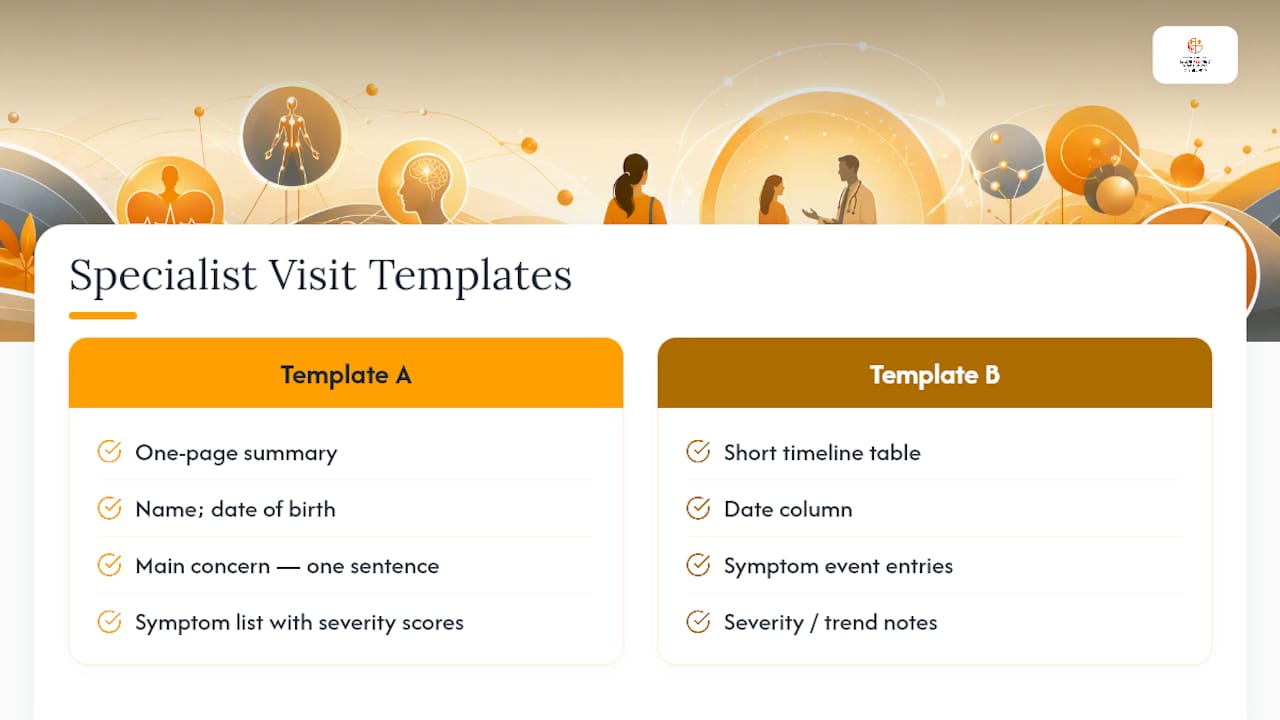
Two templates cover most needs. Template A is your one-page summary: name, date of birth, main concern in one sentence, symptom list with severity scores, current medications, allergies, and your top three questions. Template B is a short timeline table:
Compress a long medical history into a single-page executive summary by cutting anything older than two years unless it directly relates to the current concern.
Pro Tip: Update chronic-condition summaries monthly. For symptoms that are actively changing, update weekly so the timeline reflects the real trend, not a stale snapshot.
GLOBALLMED Medical Center’s guide on pre-consultation medical history essentials breaks down how to compress years of records into that one page.
What to Bring to a Specialist Visit
Pack four essentials every time: your one-page summary, recent test results or imaging discs, a current medication and allergy list, and your photo ID with insurance card. If a prior specialist or your primary care provider wrote notes about this specific concern, bring copies even if you already assume the office has them on file.
Useful extras depend on your situation. A printed symptom tracker, home readings like blood pressure, glucose, or weight with dates attached, or clear photos of a rash or wound all give the specialist something concrete to examine rather than a description alone.
If you need an interpreter, use mobility aids or hearing aids, or want a caregiver present for the conversation, tell the front desk when you check in, not after you’re called back.
- One-page summary and timeline
- Test results, imaging, or prior specialist notes
- Medication and allergy list
- Photo ID and insurance card
- Accessibility needs communicated at check-in
Pro Tip: Note a preferred contact person and phone number on your summary if you want someone else looped in on results or follow-up calls.
How to Communicate Symptoms Clearly During the Appointment
Open with your one-line summary and your single biggest concern before anything else. That gives the specialist a frame for every question that follows, rather than making them piece one together.
The Ask Me 3 framework, developed by patient-safety researchers, gives you a simple structure for the end of the visit: What is my main problem? What do I need to do? Why is it important? Asking these three questions directly improves how much patients understand and remember afterward.
Describe symptoms in plain, factual terms rather than guessing at a diagnosis yourself. “Sharp pain when I bend my knee” is more useful than “I think it’s my meniscus.”
- State your one-line summary first
- Ask your top three questions before time runs out
- Use plain, factual language over guesswork
- Request teach-back or written instructions if anything is unclear
Pro Tip: Before you leave, ask the specialist to name the single most important action you should take first. That one answer often matters more than everything else discussed.
After the Visit: Follow-Up and When to Call
Write down the diagnosis, any tests ordered, the next steps, and who is responsible for each one, before you leave the building if possible.
- Update your one-page summary with the new information
- Add any new medications or tests, with dates
- Schedule the follow-up appointment and confirm who will send results to whom
- Note specific red flags that mean you should call sooner
Watch for worsening patterns rather than isolated bad moments: symptoms that spread, new weakness, fever, or a pain level that climbs past what you reported at the visit. Symptom-checker tools built for triage guidance can help you judge whether something needs urgent attention between scheduled visits.
Pro Tip: Record a 30 to 60 second voice memo right after the appointment while instructions are still fresh. It’s faster than typing and easier to review than trying to recall a rushed conversation later.
GLOBALLMED Medical Center’s page on coordinating care between multiple specialists is worth reading if more than one clinician is involved in your case.
What Phrasing Gets a Specialist’s Attention Fastest?
Five sentences, used at the right moment, do more work than a long explanation:
- “My main concern today is X, and it’s rated Y out of 10.”
- “This started on [date] and has [improved/worsened/stayed the same] since.”
- “I tried [treatment] for [duration] and it [helped/didn’t help].”
- “What is my main problem, and what should I do next?”
- “Can you write that down or explain it in plain terms?”
Brief, prioritized phrasing works because specialists often review your chart before you arrive and have limited time to fill gaps. Starting with your goal for the visit, rather than a general history, focuses the conversation on an accurate diagnosis and a workable plan from the first minute.
The Ask Me 3 framework and similar structured-question approaches, promoted by patient-safety organizations, are associated with better patient recall and clearer follow-through on medical instructions.
GLOBALLMED Medical Center’s overview of patient care best practices for outpatient visits covers more of this communication research in detail.
Book Your Specialist Visit With a Clear Plan in Hand
A well-prepared symptoms list only pays off if the specialist behind the desk has the depth of expertise to act on it. GLOBALLMED Medical Center operates as Macau’s largest private outpatient clinic, with specialists across general practice, ENT, dermatology, urology, OB/GYN, and more who work from exactly the kind of one-page summary and timeline this article outlines. Bring your prepared documents to your specialist consultation and the visit moves faster from the first minute. If you’re weighing which department fits your concern, the full services overview lays out every specialty available, and you can schedule directly through the GLOBALLMED Medical Center booking page.
Frequently Asked Questions
How far in advance should I prepare my symptoms list for a specialist visit? Start three to seven days before the appointment. That gives you time to draft the summary, confirm records arrived, and revise your top three questions without rushing.
What’s the most important thing to include when I list symptoms for a doctor? Severity on a 0 to 10 scale paired with a specific trigger. “Pain, 7/10, worse when climbing stairs” tells a specialist far more than “my knee hurts a lot.”
Should I bring a caregiver to help report symptoms? Yes, especially if memory, language, or mobility make independent reporting harder. Ask the caregiver to note only what they directly observed, with dates, rather than their own interpretation.
What questions to ask a specialist matter most if I only have time for a few? Ask what your main problem is, what you need to do about it, and why that action matters. This Ask Me 3 structure covers diagnosis, next steps, and rationale in three short questions.
How do I know which symptoms to report to the doctor between scheduled visits? Report new or worsening symptoms, spreading pain, fever, or any level that climbs past what you noted at your last appointment. When in doubt, call the office rather than waiting for the next scheduled date.
This article is general information, not a substitute for advice from a qualified doctor. Consult a qualified healthcare professional about your own circumstances before acting on anything here.