Outpatient Cross-Border Referral: A Patient’s Guide

Outpatient cross-border referral is defined as the formal process by which a patient receives a referral from their home-country healthcare provider to access planned outpatient medical care in another country, followed by reimbursement through their home health system. This process is governed in Europe primarily by EU Cross-Border Healthcare Directive 2011/24/EU, which establishes patient rights to seek treatment abroad and claim reimbursement under specific conditions. As of 2024, 74.7% of cross-border care requests under the EU Directive were authorized across 29 reporting countries. That figure reflects how established this pathway has become for patients seeking specialized care outside their home system. GLOBALLMED Medical Center, a private outpatient center in Macau, is one example of a destination facility that accepts international patients through structured referral pathways.
What is outpatient cross-border referral and how does it work?
Outpatient cross-border referral is the recognized industry term for planned, non-emergency medical care sought abroad through a formal referral mechanism. The process begins when a patient’s home-country general practitioner or specialist determines that a specific outpatient service is needed and issues a referral to a foreign provider. Unlike inpatient admissions, outpatient referrals generally do not require prior notification or prior authorization from the home health authority, which simplifies the administrative pathway considerably. The patient then contacts the foreign outpatient clinic directly, submits the referral documentation, and awaits clinical acceptance. Once accepted, the patient travels, receives care, pays the provider directly, and later files a reimbursement claim with their home health insurer or national health authority.
The distinction between outpatient and inpatient referrals matters significantly. Inpatient care, which involves overnight stays or complex surgical procedures, typically triggers mandatory prior authorization requirements in most EU member states. Outpatient visits, by contrast, move through a lighter administrative track, making them more accessible for patients who need specialist consultations, diagnostic imaging, or minor procedures abroad.

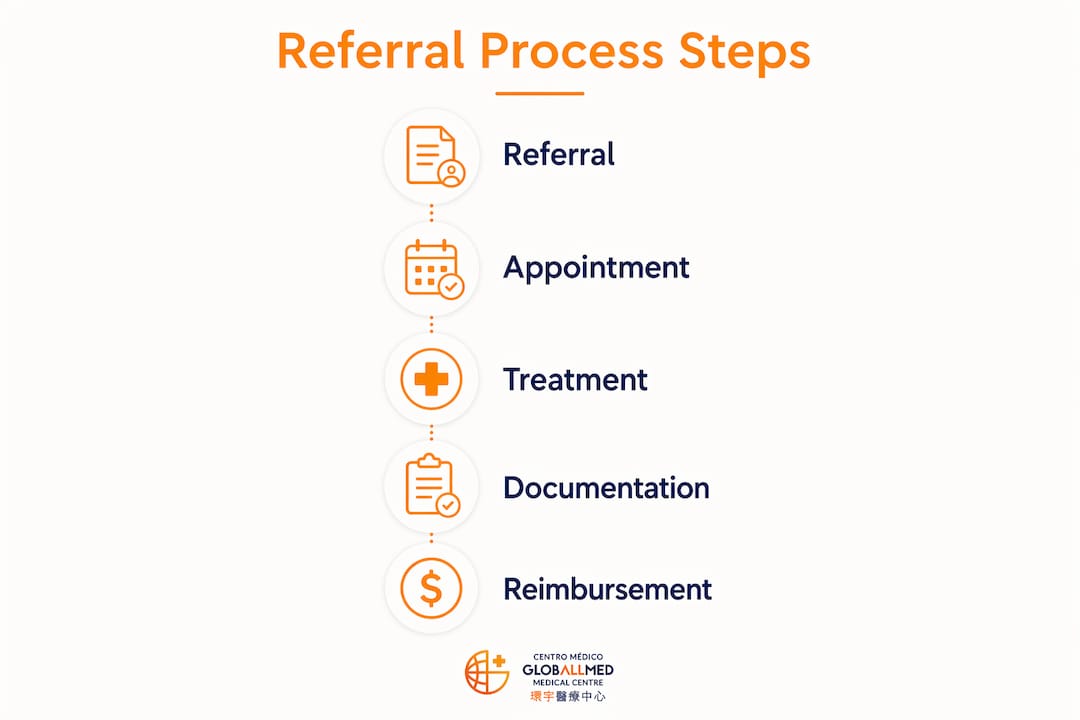
The step-by-step outpatient referral process
The outpatient referral process follows a clear sequence that patients must understand before traveling.
- Obtain a formal referral. Your home-country GP or specialist writes a referral letter that includes your diagnosis, clinical history, the specific service requested, and any relevant test results or imaging reports.
- Contact the foreign outpatient provider. Submit the referral package to the destination clinic. Foreign clinics screen referrals for clinical sufficiency before confirming an appointment, so incomplete documentation causes delays.
- Confirm appointment and travel. Once the clinic accepts the referral, schedule your appointment and arrange travel. Verify the clinic’s accepted payment methods and fee schedule before departure.
- Attend the appointment and pay directly. You pay the foreign provider at the time of service. Cross-border healthcare rights do not cover treatment costs upfront on your behalf.
- Collect all documentation. Retain every receipt, invoice, medical report, and clinical note. Missing documents are the most common reason reimbursement claims are denied.
- File a reimbursement claim. Submit your full documentation package to your home health authority or insurer within the required timeframe.
Pro Tip: Request a written clinical summary from the foreign specialist at the end of your appointment. This document serves two purposes: it supports your reimbursement claim and ensures your home GP has the information needed to continue your care.
Understanding the outpatient treatment workflow before you travel removes most of the uncertainty patients encounter during this process.
How do payment and reimbursement work for outpatient cross-border referrals?
Payment in cross-border outpatient care is always the patient’s immediate responsibility. You pay the foreign clinic directly at the time of service, then seek reimbursement from your home health system afterward. This is the single most misunderstood aspect of cross-border healthcare rights.
Key financial facts every patient must know:
- Reimbursement is capped at home-country tariffs. Your home health authority reimburses you based on what the same service would cost in your home country, not what the foreign provider charged.
- Out-of-pocket gaps are common. If the foreign clinic charges more than your home country’s public tariff for that service, you absorb the difference personally.
- EHIC does not apply. The European Health Insurance Card covers emergency care only. Planned outpatient care abroad falls under the Cross-Border Healthcare Directive, not EHIC rules.
- Verify reimbursement limits before traveling. Contact your home health authority to confirm the exact reimbursement ceiling for your specific procedure before you book.
- Documentation is non-negotiable. Claims without itemized invoices, proof of payment, and clinical reports are routinely rejected.
Reimbursement under the EU Cross-Border Healthcare Directive does not guarantee free treatment abroad. Patients must pay the foreign provider directly and can only recover costs up to the amount their home country would pay for the equivalent service. Any difference between the foreign fee and the home-country tariff is an out-of-pocket expense the patient must plan for in advance.
Understanding the elective procedure cost framework before committing to a foreign provider protects you from unexpected financial exposure.
What are the key challenges in managing outpatient cross-border referrals?
Outpatient cross-border referrals carry administrative complexity that patients routinely underestimate. The most frequent failure points fall into three categories: communication gaps, documentation errors, and financial miscalculations.
Communication between providers is the most critical risk. Closed-loop communication between the foreign specialist and the patient’s home GP is a recognized failure point in referral management. When the foreign clinic does not send a consultation report back to the referring physician, continuity of care breaks down. Patients should request that the foreign provider transmit a full clinical summary directly to their home GP.
Incomplete referral data causes rejection before treatment begins. Foreign clinics assess every incoming referral for clinical adequacy. If your referral letter lacks sufficient diagnostic detail, the clinic returns it without scheduling an appointment. This delays treatment and requires the home provider to revise and resubmit the documentation.
Best practices for managing these challenges:
- Confirm with your home GP that the referral letter meets the destination clinic’s stated requirements before submission.
- Keep a personal copy of every document you submit and receive throughout the process.
- Verify your home country’s reimbursement limits for your specific procedure before signing any treatment agreement abroad.
- Ask the foreign clinic explicitly whether they will send a post-consultation report to your home provider.
- Use digital patient portals where available, as digital referral platforms reduce manual errors and improve pricing transparency across borders.
Pro Tip: Before traveling, request a written cost estimate from the foreign clinic and compare it against your home country’s published tariff for the same procedure. The gap between those two figures is your minimum out-of-pocket exposure.
Patients who review common outpatient concerns before initiating a referral are better prepared for the administrative steps involved.
How does outpatient cross-border referral compare to inpatient or emergency care?
The three main cross-border healthcare pathways differ significantly in authorization requirements, payment rules, and documentation standards.
| Feature | Outpatient referral | Inpatient referral | Emergency care (EHIC) |
|---|---|---|---|
| Referral required | Yes, from home GP or specialist | Yes, typically more detailed | No |
| Prior authorization | Generally not required | Often required | Not applicable |
| Payment method | Patient pays upfront | Patient pays upfront | Covered by EHIC at point of care |
| Reimbursement basis | Home country tariff | Home country tariff | Not applicable |
| Documentation burden | High | Very high | Low |
| Scheduling | Patient-initiated | Coordinated between providers | Emergency-driven |
| Continuity of care risk | Moderate | Lower, due to closer coordination | Variable |
Outpatient care is the most accessible cross-border pathway because it skips the prior authorization step required for most inpatient procedures. As of 2024, 19 EU member states require prior authorization for at least some treatments, and that requirement applies almost exclusively to inpatient or high-cost procedures. That regulatory structure makes outpatient referrals the practical entry point for most patients exploring cross-border healthcare options.
Emergency care under EHIC operates on entirely different rules. It covers unplanned, medically necessary treatment during a temporary stay abroad and requires no referral, no upfront payment in most cases, and no reimbursement claim. Patients who confuse EHIC coverage with planned outpatient referral rights often arrive abroad without the documentation or funds needed to access care correctly.
For patients considering medical tourism in 2026, understanding which pathway applies to their situation is the first decision to get right.
Key Takeaways
Outpatient cross-border referral requires upfront payment, strict documentation, and reimbursement capped at home-country tariffs, making financial preparation and complete paperwork the two most critical patient responsibilities.
| Point | Details |
|---|---|
| Definition is specific | Outpatient cross-border referral means planned care abroad via a home-provider referral, not emergency or inpatient care. |
| Authorization is usually not required | Most EU outpatient referrals skip prior authorization, unlike inpatient procedures in 19 member states. |
| Reimbursement has a ceiling | Home-country tariffs cap reimbursement, so patients must verify limits before committing to foreign provider fees. |
| Documentation drives success | Missing receipts, invoices, or clinical reports are the leading cause of reimbursement claim denial. |
| Communication closes the loop | Patients must request that foreign specialists send consultation reports back to their home GP to maintain care continuity. |
What I have learned from watching patients navigate cross-border outpatient care
The administrative side of cross-border outpatient referrals is where most patients struggle, not the clinical side. Patients spend significant energy selecting the right foreign specialist, then arrive with an incomplete referral letter that the destination clinic cannot accept. The clinical decision is sound. The paperwork is not.
The reimbursement misconception is equally persistent. Patients genuinely believe that cross-border healthcare rights mean free treatment abroad. They do not. The right is to reimbursement, capped at what your home system would pay. That distinction changes the financial planning required before any trip.
The trend toward digital referral management is real and meaningful. Platforms that automate referral submission, document verification, and pricing transparency reduce the manual burden that currently falls entirely on the patient. That shift has not yet reached most patients, but it is coming.
My strongest recommendation is this: before you book any appointment abroad, call your home health authority and ask for the exact reimbursement ceiling for your specific procedure code. Then ask the foreign clinic for a written fee estimate. The gap between those two numbers is your out-of-pocket cost. If you can afford that gap, proceed. If not, reconsider the destination or the timing.
Selecting a foreign outpatient provider that has experience with international patients, offers transparent pricing, and commits to sending post-consultation reports back to your home provider eliminates most of the problems I have seen derail cross-border referrals. GLOBALLMED Medical Center operates with exactly that model for patients traveling to Macau.
— IGHS
GLOBALLMED Medical Center and outpatient cross-border patients
GLOBALLMED Medical Center is Macau’s largest private outpatient clinic, structured to receive international patients through formal referral pathways. The center’s medical specialties and outpatient services cover a broad range of clinical disciplines, with multilingual staff who support patients through documentation requirements and post-consultation reporting.

Patients referred to GLOBALLMED Medical Center receive transparent fee estimates before their appointment, which allows direct comparison against home-country reimbursement tariffs. The center’s coordination team assists with clinical documentation, ensuring that consultation reports reach the referring home provider after each visit. Patients seeking cross-border outpatient care in the Asia-Pacific region can review the full range of outpatient services at GLOBALLMED Medical Center and contact the center directly to confirm referral acceptance criteria for their specific clinical need.
FAQ
What is outpatient cross-border referral in simple terms?
Outpatient cross-border referral is the process of receiving a referral from your home-country doctor to access planned, non-emergency medical care at a clinic in another country, followed by reimbursement from your home health system.
Do I need prior authorization for outpatient cross-border care?
Most outpatient referrals under the EU Cross-Border Healthcare Directive do not require prior authorization, unlike inpatient procedures, which trigger mandatory authorization in 19 EU member states as of 2024.
How much will I be reimbursed for treatment abroad?
Reimbursement is capped at the amount your home country would pay for the same service domestically. If the foreign provider charges more, you pay the difference out of pocket.
What documents do I need to file a reimbursement claim?
You need the original referral letter, itemized invoices, proof of payment, and the foreign specialist’s clinical report. Missing any of these documents is the most common reason claims are denied.
Is EHIC the same as cross-border healthcare rights?
No. The European Health Insurance Card covers emergency care during temporary stays abroad. Planned outpatient referrals fall under the EU Cross-Border Healthcare Directive, which operates through a separate reimbursement mechanism and requires upfront payment by the patient.