Rhinoplasty Recovery Timeline: Your Week-by-Week Guide
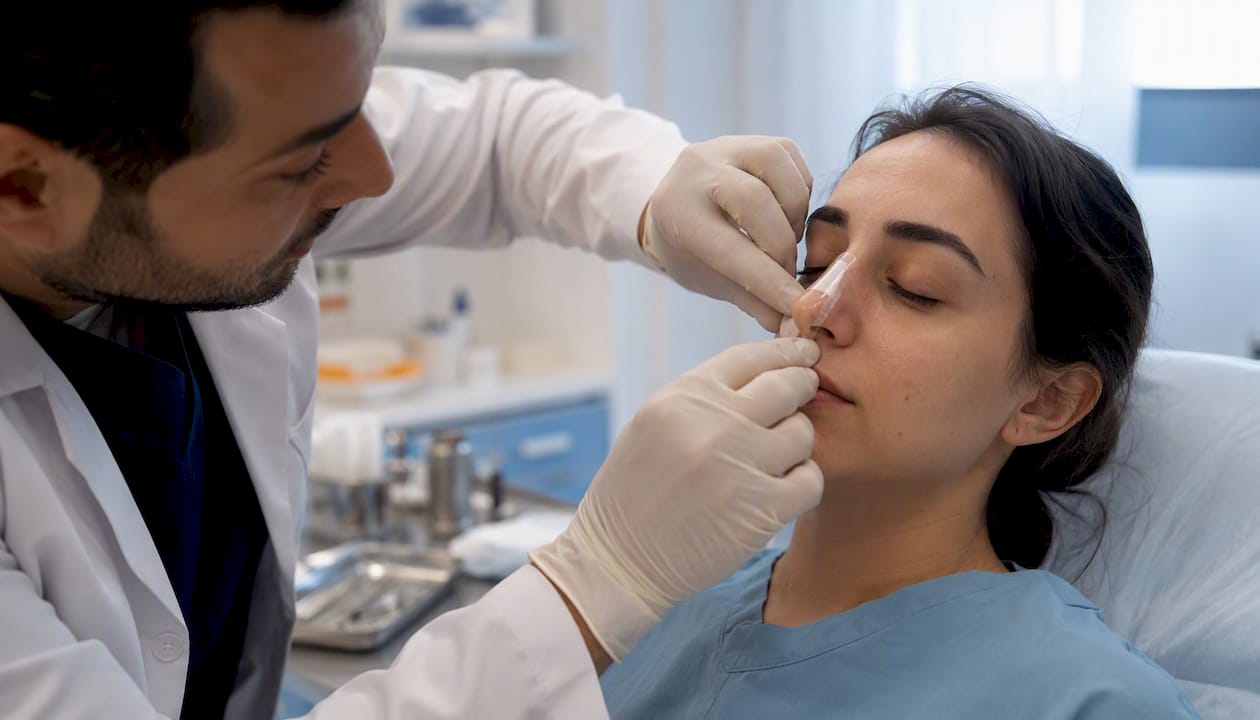
Most patients reach a socially presentable stage within about a week of rhinoplasty; major swelling subsides over several weeks; and subtle refinement continues for many months. The external splint typically comes off around day 5 to 7. Bruising fades through the next few weeks, and the nasal tip, which holds swelling the longest, may not fully settle until many months later. Every individual’s rhinoplasty recovery timeline shifts based on surgical complexity, skin thickness, and personal health factors, so treat these windows as evidence-based benchmarks rather than guarantees. This article is general health information, not a substitute for your surgeon’s specific instructions.
- ~1 week: Socially presentable; splint removed; desk work often possible
- 4–6 weeks: Major swelling substantially reduced; light exercise resumes
- 3–6 months: Ongoing soft-tissue refinement; breathing stabilizes
- Up to 12 months: Final subtle contour changes, especially at the nasal tip
Key Takeaways
The rhinoplasty recovery timeline follows a predictable arc: one week to social presentability, 4–6 weeks for major swelling to subside, 3–6 months for ongoing refinement, and up to 12 months for the final subtle changes at the nasal tip.
| Point | Details |
|---|---|
| Splint removal and early return to work | The external splint comes off around day 5–7; desk work is often possible after one week off prescription medication. |
| Major swelling window | Visible swelling reduces substantially by 4–6 weeks; strenuous exercise resumes at this point with surgeon clearance. |
| Tip swelling takes longest | The nasal tip holds swelling the longest and may not fully settle until the 12-month mark. |
| Revision surgery timing | Wait a full 12 months before assessing whether revision is needed, unless a functional problem requires earlier action. |
| GLOBALLMED Medical Center | Offers outpatient pre-op and post-op consultations in Macau for patients planning or recovering from rhinoplasty. |
Table of Contents
- What should you do before rhinoplasty to prepare for recovery?
- What happens in the first 72 hours after rhinoplasty?
- What changes during the first week after rhinoplasty?
- What should you expect in the second week of recovery?
- What milestones should you expect by the end of the first month?
- How does swelling change between months 1 and 3?
- What happens between months 3 and 6?
- When do you see the final results of rhinoplasty?
- How do you manage swelling, pain, and incision care at home?
- When can you resume normal activities after rhinoplasty?
- What warning signs should prompt you to call your surgeon?
- What factors lengthen or shorten your recovery?
- Authoritative sources for further reading
- GLOBALLMED Medical Center supports your rhinoplasty recovery in Macau
What should you do before rhinoplasty to prepare for recovery?
The decisions you make in the two weeks before surgery have a direct effect on how smoothly the rhinoplasty healing process unfolds. Preparation is not optional.
Pre-op checklist:
- Stop aspirin, ibuprofen, naproxen, and any blood-thinning supplements (fish oil, vitamin E, ginkgo) at least 10–14 days before surgery, per your surgeon’s guidance.
- Quit smoking at least four weeks before the procedure. Nicotine constricts blood vessels, slows tissue oxygenation, and meaningfully extends healing time.
- Arrange a responsible adult to drive you home and stay with you for the first 24–48 hours.
- Prepare your sleep station in advance: two to three firm pillows or a wedge pillow to keep your head elevated at roughly 30–45 degrees.
- Stock the refrigerator with soft foods, cold compresses, and any prescribed medications filled ahead of time.
- Choose loose, front-opening clothing for the day of surgery. Pullover tops that brush the nose are a common and avoidable problem.
- Confirm your follow-up appointment schedule before the procedure date.
Pro Tip: Set up your recovery space the night before surgery, not the morning of. Tape a note to your bathroom mirror reminding you not to blow your nose. Small environmental cues prevent the most common early mistakes.
Patients planning rhinoplasty in Macau can schedule a pre-operative consultation through GLOBALLMED Medical Center’s outpatient clinic to review preparation protocols and confirm their personal checklist with a licensed clinician.
What happens in the first 72 hours after rhinoplasty?
The first three days are the most physically demanding part of the rhinoplasty recovery timeline. Swelling peaks, discomfort is at its highest, and the risk of complications is greatest. The single most important actions during this window: rest completely, keep your head elevated above heart level at all times, apply cold packs around (never directly on) the nose, and avoid any straining, bending, or nose-blowing.
Splint and dressing care:
- The external splint stays in place for approximately one week. Do not get it wet.
- Nasal packing, when used, is typically removed within 24–48 hours at your surgeon’s office. Breathing through the nose will feel blocked until then.
- A small drip pad (gauze taped under the nostrils) absorbs any blood-tinged drainage. Change it when saturated, but do not pack anything inside the nostrils yourself.
Pain control:
- Most surgeons prescribe a short course of oral analgesics. Take them on schedule for the first 48 hours rather than waiting for pain to peak.
- Avoid aspirin, ibuprofen, and other NSAIDs unless your surgeon explicitly clears them. These increase bleeding risk.
- Acetaminophen (Tylenol) is generally safe for breakthrough discomfort, but confirm the dose with your surgical team.
Warning signs requiring immediate contact with your surgeon or emergency care:
- Heavy, continuous bleeding that soaks through multiple drip pads within an hour
- Rapidly expanding bruising or swelling on one side only
- Fever above 101°F (38.3°C)
- Severe, uncontrolled pain that does not respond to prescribed medication
- Sudden difficulty breathing through the mouth
What changes during the first week after rhinoplasty?
Days 3–7 bring the most visible bruising, followed by the first real signs of improvement. Swelling peaks around day 2–3 and then begins a gradual, uneven retreat.
Day-by-day expectations:
- Days 3–4: Bruising under the eyes is typically at its darkest. Swelling around the cheeks and upper lip is common and normal.
- Days 5–7: Bruising begins shifting from purple-blue to yellow-green as the body reabsorbs blood. The surgeon removes the external splint and any non-dissolving sutures at this visit, usually around day 5–7.
- Day 7: Many patients can return to nonstrenuous desk work after one week, provided pain is controlled and they are off prescription opioids.
At the first postoperative visit, your surgeon will assess the incision line, check for any early signs of infection, and give clearance for specific activities. Bring a list of any symptoms you noticed at home, including any changes in sensation or unexpected asymmetry.
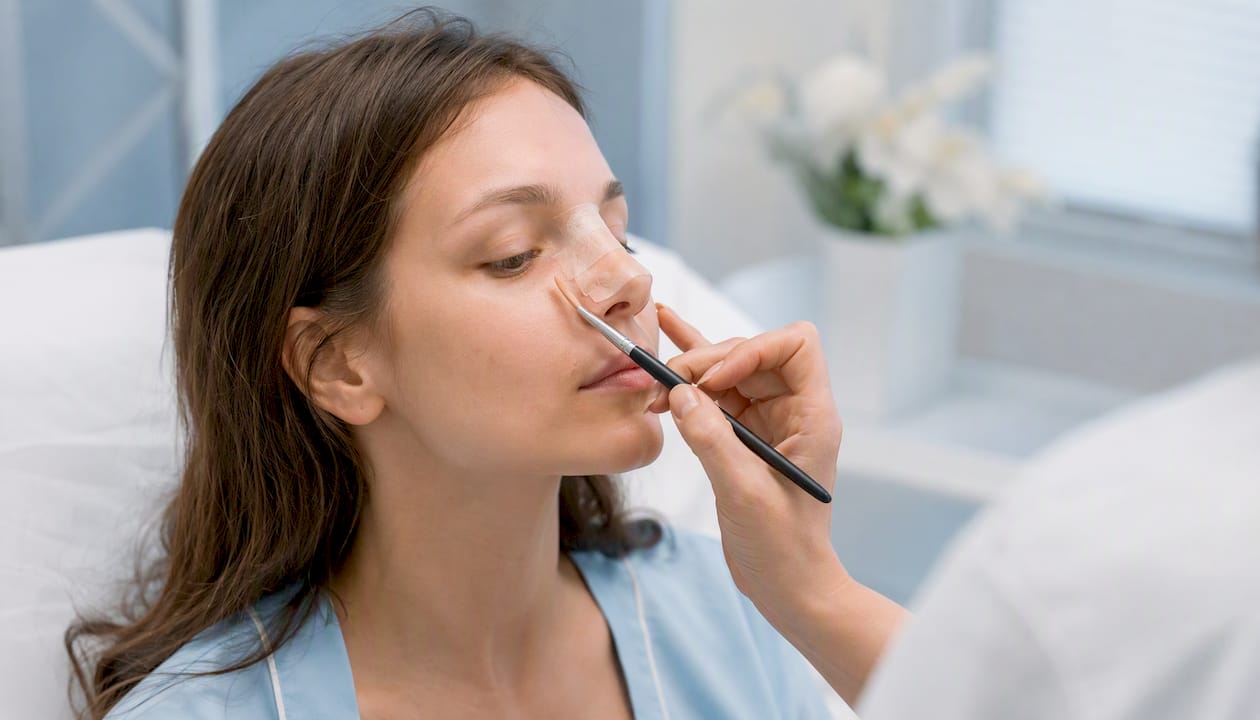
For social re-entry, color-correcting concealer (peach or orange-toned for blue-purple bruising) applied gently with a brush, not a sponge, can reduce visible discoloration significantly. Avoid any pressure directly on the nasal bridge.
Driving is generally not advisable while taking prescription pain medication or while the splint is in place, as peripheral vision and reaction time may be affected.
What should you expect in the second week of recovery?
Week two is when most patients begin to feel like themselves again, though the nose still looks swollen and the skin may feel tight or numb.
Expected changes:
- Bruising continues fading and is often minimal by day 10–12 in patients with lighter skin tones.
- Swelling becomes more localized, concentrating around the nasal tip and bridge rather than spreading across the face.
- Sensation begins returning to the nasal skin and tip, sometimes accompanied by itching or tingling. This is normal nerve recovery.
- Gentle facial expressions, including smiling and laughing, are generally safe after the first two weeks, though patients should be careful in the earliest days to avoid any pressure on the nose.
Activity cautions:
- Avoid lifting anything heavier than 10 pounds.
- Do not wear glasses that rest on the nasal bridge. Use contact lenses or tape glasses to the forehead until cleared by your surgeon.
- Choose clothing that buttons or zips at the front.
- Sleep on your back with your head elevated. Side sleeping risks shifting soft tissue and prolonging swelling.
Pro Tip: When reintroducing social activities in week two, plan low-key outings first. A coffee meeting is lower risk than a crowded event where someone might accidentally bump your nose. Residual bruising under concealer is barely noticeable in warm or dim lighting.
What milestones should you expect by the end of the first month?
Weeks 3–4 mark a meaningful turning point. Most bruising is gone, and the nose begins to look closer to its intended shape, though it will still appear larger than the final result.
Weeks 3–4 milestones:
- Bruising is typically resolved or nearly invisible by week three.
- Swelling is noticeably reduced but the nose remains puffy, particularly at the tip.
- Most patients can resume light aerobic activity, such as walking or gentle cycling, around weeks 3–4, provided there is no impact risk and the surgeon has given clearance.
- NHS guidance notes that bruising and swelling may improve by three weeks, with strenuous exercise resuming at 4–6 weeks.
Common symptoms at this stage:
- Nasal congestion and a sensation of stuffiness that does not respond to decongestants. This is internal swelling, not infection, and it resolves gradually.
- Numbness or reduced sensation at the nasal tip. Nerve recovery is slow and can take several months.
- Itching along incision lines as tissue heals.
Sun protection matters from this point forward. UV exposure can darken incision scars and prolong redness in nasal skin. Use SPF 30 or higher on any exposed scar tissue and avoid prolonged direct sun on the nose.
How does swelling change between months 1 and 3?
The subacute phase, roughly weeks 4–12, is when the rhinoplasty healing process becomes less dramatic but no less important. Swelling retreats in layers, and the nose refines gradually rather than in visible jumps.
What to expect:
- The dorsum (bridge) typically clears of visible swelling faster than the tip. Patients often notice the bridge looking close to its intended shape by weeks 6–8, while the tip remains rounder and less defined.
- Breathing function, when the procedure addressed the septum or turbinates, usually stabilizes by weeks 6–8 as internal swelling resolves.
- Morning puffiness, where the nose looks slightly larger upon waking and improves through the day, is normal and gradually decreases.
Most swelling resolves within 3–4 weeks for the bulk of visible puffiness, while bones, if osteotomies were performed, typically heal in about six weeks.
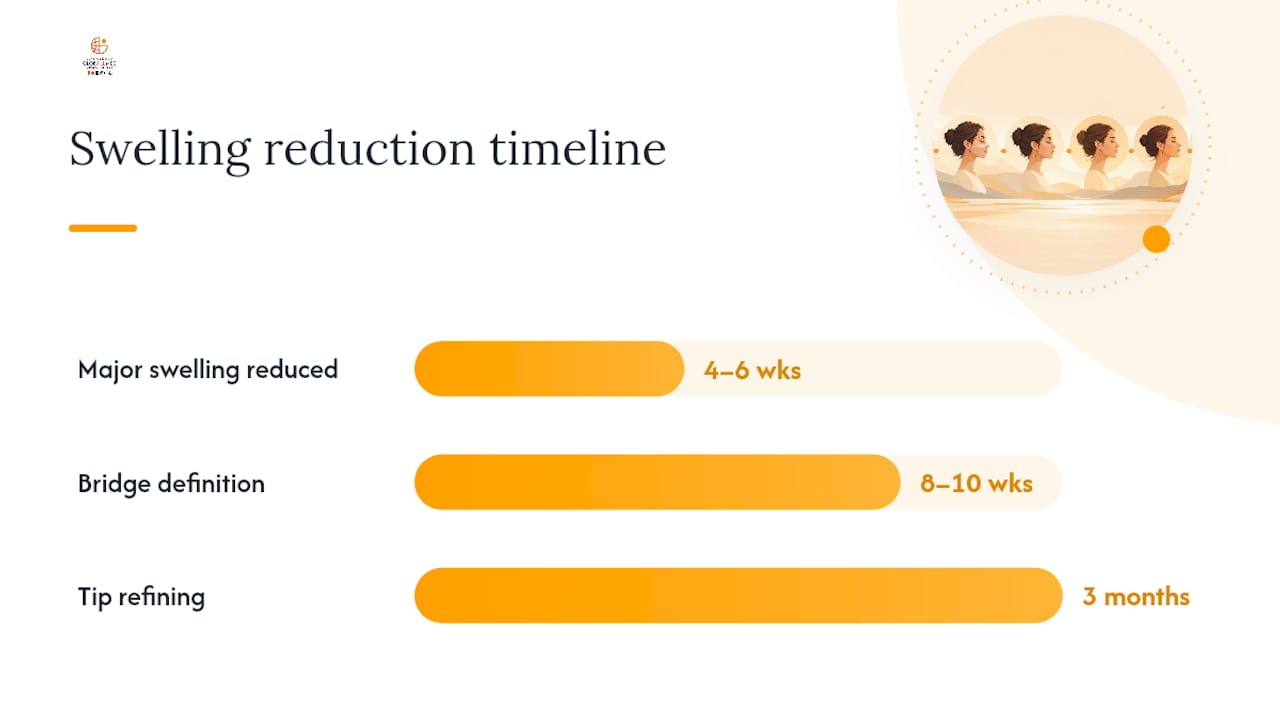
| Checkpoint | Approximate swelling resolved | Key milestone |
|---|---|---|
| 4–6 weeks | Major visible swelling substantially reduced | Strenuous exercise clears; bone healing underway |
| 8–10 weeks | Bridge definition improving | Breathing often stabilizes |
| 3 months | Tip still refining | Most functional recovery complete |
Clinical follow-up during this phase typically involves a check at the 6–8 week mark and again around month 3. Raise any concerns about persistent nasal obstruction at these visits rather than waiting. Early reporting allows your surgeon to distinguish normal healing from a structural issue that may need attention.
What happens between months 3 and 6?
By month three, most patients feel functionally recovered. The changes between months 3–6 are subtler but clinically significant, particularly for the soft tissue overlying the nasal tip.
Expected changes:
- Ongoing soft-tissue thinning as residual edema continues to reabsorb.
- Improved nasal definition, especially at the tip and alar base.
- Reduced morning puffiness compared to earlier months.
- Incision scars, if an open rhinoplasty was performed, continue to fade and flatten.
At this stage, surgeons often take standardized photographs to document progress and compare against pre-operative images. These photos serve as an objective record and are useful if revision discussions arise later.
For scar care, silicone gel or silicone sheeting applied to the columellar incision (the small scar under the nose) can support flattening and fading. Sun protection remains important throughout this phase.
Conservative surgeons typically defer any revision discussions until at least 12 months post-operation. A conversation about revision at month 4 or 5 is premature unless there is a functional concern.
When do you see the final results of rhinoplasty?
The 6–12 month window is where the last, most subtle changes occur. For most patients, the nose at six months looks very close to the final result, but the tip and soft tissues continue refining.
What “final” looks like at each stage:
- 6 months: The bridge and overall profile are close to their permanent shape. Tip definition is still improving.
- 9 months: Tip swelling has largely resolved. Skin that was thicker pre-operatively may still show mild puffiness.
- 12 months: Considered the standard endpoint for assessing final results. Subtle changes can still occur beyond this point in patients with thick skin or complex grafting.
Major visible swelling typically decreases substantially by 4–6 weeks, but subtle swelling, especially in the tip, can persist up to a year.
Decision rule for revision surgery: Most plastic surgeons recommend waiting a full 12 months before assessing whether revision is warranted, unless a functional problem (breathing obstruction, infection, structural collapse) requires earlier intervention. Asymmetry that is visible at month 4 may resolve entirely by month 10. Patience at this stage is not passive; it is clinically appropriate.
The nasal tip and overlying soft tissues take the longest to settle because they have the highest density of lymphatic vessels and the thickest skin relative to the underlying cartilage framework.
How do you manage swelling, pain, and incision care at home?
A consistent home regimen meaningfully shortens the period of visible swelling and reduces discomfort. The fundamentals are straightforward, but the details matter.
Do and don’t list:
- Do apply cold compresses to the cheeks and around the eyes (never directly on the nose or splint) for 20 minutes on, 20 minutes off during the first 48–72 hours.
- Do keep your head elevated above heart level, including during sleep, for at least the first two weeks.
- Do take prescribed medications on schedule for the first 48 hours. Staying ahead of pain is easier than catching up to it.
- Don’t blow your nose for at least three weeks. Sniff gently or dab with a soft tissue.
- Don’t use NSAIDs (ibuprofen, aspirin, naproxen) unless your surgeon has explicitly approved them.
- Don’t apply heat to the nose or face during the first month. Heat increases blood flow and worsens swelling.
- Don’t submerge your face in water (pools, hot tubs, baths) until incisions are fully healed and your surgeon clears it.
Incision care:
- Clean the incision line gently with saline or as directed by your surgeon.
- Apply any prescribed ointment (commonly petroleum-based) to keep the incision moist and reduce crusting.
- Do not pick at scabs or suture sites.
Pro Tip: Sleep with your head elevated on a wedge pillow rather than stacking standard pillows, which shift during the night. A wedge maintains a consistent angle and prevents you from rolling onto your side unconsciously.
When can you resume normal activities after rhinoplasty?
Clear timelines for returning to specific activities reduce the guesswork and protect the surgical result.
| Activity | Recommended timeline |
|---|---|
| Desk work / light office tasks | After 1 week (when off prescription pain medication) |
| Driving | When pain is controlled, splint is off, and you are not on opioids |
| Light walking | Days 3–5 (gentle, no impact) |
| Light aerobic exercise | Weeks 3–4 |
| Strenuous exercise / gym | 4–6 weeks, per surgeon clearance |
| Heavy lifting (over 20 lbs) | 4–6 weeks |
| Contact sports | Approximately 3 months, or per surgeon instruction |
| Flying / air travel | Typically 1–2 weeks post-op; confirm with surgeon (pressure and congestion are factors) |
| Wearing glasses on the bridge | Avoid for 4–6 weeks; use contact lenses or tape glasses to forehead |
| Swimming / submerging face | 4–6 weeks minimum, when incisions are fully healed |
Flying within the first week carries risks: cabin pressure changes can worsen nasal congestion and increase swelling. If travel is unavoidable, use saline nasal spray and stay well hydrated. Confirm the specific window with your surgeon before booking.
Glasses that rest on the nasal bridge can indent healing cartilage and shift the surgical result. Contact lenses are the preferred option during the first 4–6 weeks. If contacts are not an option, lightweight frames taped to the forehead with medical tape distribute weight away from the bridge.
What warning signs should prompt you to call your surgeon?
Most rhinoplasty recoveries proceed without serious complications. Knowing which symptoms are urgent and which are expected prevents both unnecessary panic and dangerous delays.
Urgent signs, contact your surgeon immediately or go to the emergency department:
- Heavy or continuous bleeding that soaks through multiple gauze pads within an hour
- Sudden complete loss of nasal airflow through both nostrils (beyond expected congestion)
- Fever above 101°F (38.3°C) persisting more than 24 hours
- Spreading redness, warmth, or red streaking around the nose or cheeks
- Severe pain that is not controlled by prescribed medication
- Rapidly expanding swelling or bruising on one side only
Concerning but non-urgent, report at your next appointment or call the office within 24 hours:
- Persistent asymmetric swelling after week four that is not improving
- Nasal obstruction that does not improve after the expected 6–8 week window
- Unusual firmness or hardness developing at the nasal tip after month two
- Suture material working its way to the surface of the skin
When you call, have ready:
- The date and time symptoms began
- A photograph taken in good lighting (front and side view)
- A list of all current medications and the last dose taken
Keep every scheduled follow-up appointment, even when you feel fine. Early detection of minor issues, such as a small stitch abscess or early scar thickening, prevents them from becoming larger problems.
What factors lengthen or shorten your recovery?
Not every rhinoplasty recovery follows the same arc. Several surgical and patient-specific variables shift the timeline in predictable ways.
Factors that extend recovery:
- Revision rhinoplasty: Scar tissue from a prior procedure reduces blood supply and slows healing. Expect a longer swelling phase than a primary case.
- Osteotomies (bone work): When the nasal bones are broken and repositioned, bone healing takes approximately six weeks, and the nose should be protected from impact for about three months.
- Cartilage grafting: Septal cartilage grafts add minimal recovery time. Ear cartilage grafts add a small secondary healing site. Rib cartilage grafts add a chest incision that requires its own healing period. Rib cartilage does not regrow once harvested; the surrounding chest tissue heals, but the cartilage itself is not regenerated.
- Thick skin: Thicker nasal skin holds edema longer and obscures refinement for more months than thin skin.
- Smoking: Active smoking at the time of surgery significantly impairs wound healing and increases infection risk.
- Medical comorbidities: Diabetes, autoimmune conditions, and chronic steroid use all slow tissue repair.
- Age: Older patients generally experience slower soft-tissue recovery, though this varies considerably.
Factors that shorten or smooth recovery:
- Primary (first-time) rhinoplasty on healthy tissue
- Soft-tissue-only procedures without osteotomies
- Non-smoking status maintained through the perioperative period
- Excellent pre-operative nutrition and hydration
Pro Tip: If your surgeon has recommended stopping a specific medication before surgery, such as a blood thinner or immunosuppressant, do not skip that step to avoid a gap in your regimen without medical guidance. Coordinate with both your surgeon and your prescribing physician at least two weeks before the procedure date.
Authoritative sources for further reading
The timeline benchmarks in this article draw from clinician-reviewed patient education resources. The following are reliable starting points for additional reading:
- NHS (National Health Service, UK): — guidance on nose reshaping notes up to two weeks off work, bruising and swelling improving by three weeks, and strenuous exercise resuming at 4–6 weeks.
- University of Utah Health: — clinicians emphasize that many patients are surprised by how long low-level swelling can remain, and that expectation-setting is critical to satisfaction.
For patients seeking local outpatient follow-up in Macau, GLOBALLMED Medical Center’s services include clinical consultations and wellness support relevant to cosmetic surgery recovery.
GLOBALLMED Medical Center supports your rhinoplasty recovery in Macau
Recovering from rhinoplasty requires consistent clinical follow-up, not just a single post-operative visit. For patients based in or traveling to Macau, GLOBALLMED Medical Center provides the outpatient infrastructure to support every phase of the rhinoplasty healing process, from pre-operative preparation through long-term scar and wellness care.

The center’s multilingual clinical team works with international patients on appointment scheduling, insurance direct billing, and coordinated care across specialties. Whether you need a pre-op consultation before your procedure, a follow-up assessment during the swelling phase, or adjunctive beauty and wellness support for scar management and skin recovery, GLOBALLMED Medical Center offers a single outpatient destination for all of it. Patients asking about rhinoplasty cost in Macau or rhinoplasty Macau cost comparisons can request a detailed consultation to understand the full scope of care and associated fees.
Book your consultation directly through the GLOBALLMED Medical Center appointment portal and bring your surgical records, current medication list, and any post-op photographs to your first visit.