
How to Coordinate Care Between Multiple Specialists

Designate one provider as your lead coordinator, prepare a one-page medical summary, and formally request that your specialists share notes with each other. That single sequence prevents the majority of coordination failures patients experience in multispecialty healthcare.
Your coordination checklist
- Designate a lead: confirm with your primary care physician (PCP) that they will serve as the central coordinator for all specialist communication
- Prepare a one-page medical summary (diagnoses, active problems, allergies, current medications with doses, recent procedures, and key test dates)
- Compile a complete medication list, including over-the-counter drugs and supplements, with dose and prescribing provider noted for each
- Sign a records release or consent form at each practice to authorize cross-provider sharing
- Request that each specialist send a visit note or summary directly to your PCP after every appointment
- Book a follow-up with your PCP within 7 days of any hospital discharge or major specialist visit
- Confirm who is responsible for ordering labs and who reviews results with you
Pro Tip: To get a fast clinician-to-clinician response, ask your PCP’s nurse to call the specialist’s nurse directly rather than waiting for a portal message. Nurse-to-nurse calls often resolve questions in hours, not days.
Pro Tip: At every new specialist visit, hand the provider your printed medication list and ask: “Are any of these medications a concern given what you’re treating?” That one question is the fastest form of medication reconciliation available to a patient.

Key Takeaways
Coordinating care between multiple specialists requires a designated lead, a one-page medical summary, and explicit requests for provider-to-provider communication at every visit.
| Point | Details |
|---|---|
| Designate a lead coordinator | Confirm your PCP will centrally manage all specialist communication and medication reconciliation. |
| Carry a one-page medical summary | Update it after every visit; it prevents duplicate tests and medication errors across providers. |
| Request formal support when needed | Ask for a care manager if you see two or more specialists with conflicting plans or take five or more daily medications. |
| Know your Medicare or insurance benefits | CCM, TCM, and PCM programs may cover coordination services for eligible patients. |
| GLOBALLMED Medical Center | Offers multispecialty outpatient consultations with coordinated scheduling for patients seeking integrated care. |
Useful sources for further reading
- AHRQ (Agency for Healthcare Research and Quality): — Defines care coordination and provides evidence-based frameworks for reducing fragmentation across providers.
- CMS / Medicare: — Describes Chronic Care Management, Transitional Care Management, and Principal Care Management programs, including eligibility and what each covers.
Table of Contents
- Why care coordination matters for patients seeing multiple specialists
- Who leads coordination and what each role must do
- Practical steps patients and caregivers can take at every visit
- How medical teams share information and what you should ask about
- What to do at key transitions: discharge, surgery, and rehab
- Common coordination breakdowns and how to fix them
- How insurance and Medicare affect care coordination services
- When to ask for a formal care manager or MDT review
- Patient toolkit: templates and scripts you can use right now
- GLOBALLMED Medical Center supports integrated multispecialty care
Why care coordination matters for patients seeing multiple specialists
Care coordination is the deliberate organization of patient care activities across multiple providers to ensure clinicians have the needed information, preferences, and responsibilities at the right time. The Agency for Healthcare Research and Quality (AHRQ) frames it as a patient-centered process designed to reduce fragmented care, including redundant testing and conflicting medications.
The stakes are real. Patients managing multiple chronic conditions often face coordination challenges such as duplicate imaging, medication interactions, and missed follow-ups. Effective coordination reduces medication errors, costs from duplicate tests, and improves disease control.
Effective care coordination requires systems-level support, reliable clinician communication channels, and active patient engagement working together. No single element alone is sufficient. NIH/PMC research on primary care coordination priorities identifies all three as necessary conditions for success.
A recent review found that cross-specialty collaborative models, including combined clinics and multidisciplinary team meetings, are linked to faster clinical decisions, better perceived disease control, and improved patient quality of life compared with siloed specialty referrals. The benefit is most pronounced in complex conditions where two or more specialists must align on a single treatment plan. For patients with chronic disease management needs, that alignment is not optional.
Who leads coordination and what each role must do
Clarifying roles up front closes that gap.
The American College of Physicians (ACP) policy guidance is direct: the primary care team should serve as the central organizer of a patient’s overall care, while specialists act as extensions of care with mutually agreed roles and bidirectional communication. Understanding the difference between a GP and a specialist helps patients know exactly what to ask of each.
| Role | Core Duties | What You Should Confirm |
|---|---|---|
| Primary Care Physician (PCP) | Coordinates overall plan, reviews all specialist notes, reconciles medications | “Will you send a summary to each specialist before my visit?” |
| Specialist | Manages the specific condition, sends visit notes to PCP, flags drug interactions | “Will you send your notes to my PCP after today?” |
| Nurse / Care Manager | Tracks follow-up tasks, schedules appointments, monitors symptoms between visits | “Who do I call if my symptoms change before my next visit?” |
| Pharmacist | Reviews full medication list, checks for interactions, counsels on adherence | “Can you review all my medications for interactions?” |
| Patient / Caregiver | Carries records, tracks symptoms, communicates changes across providers | Bring the one-page medical summary to every appointment |
Questions to ask each role:
- PCP: “Which of my specialists do you communicate with most regularly?”
- Specialist: “Do you have access to my other specialists’ notes?”
- Care manager: “What is the best way to reach you between appointments?”
- Pharmacist: “Have you reviewed my complete medication list, including what each specialist prescribed?”
Practical steps patients and caregivers can take at every visit
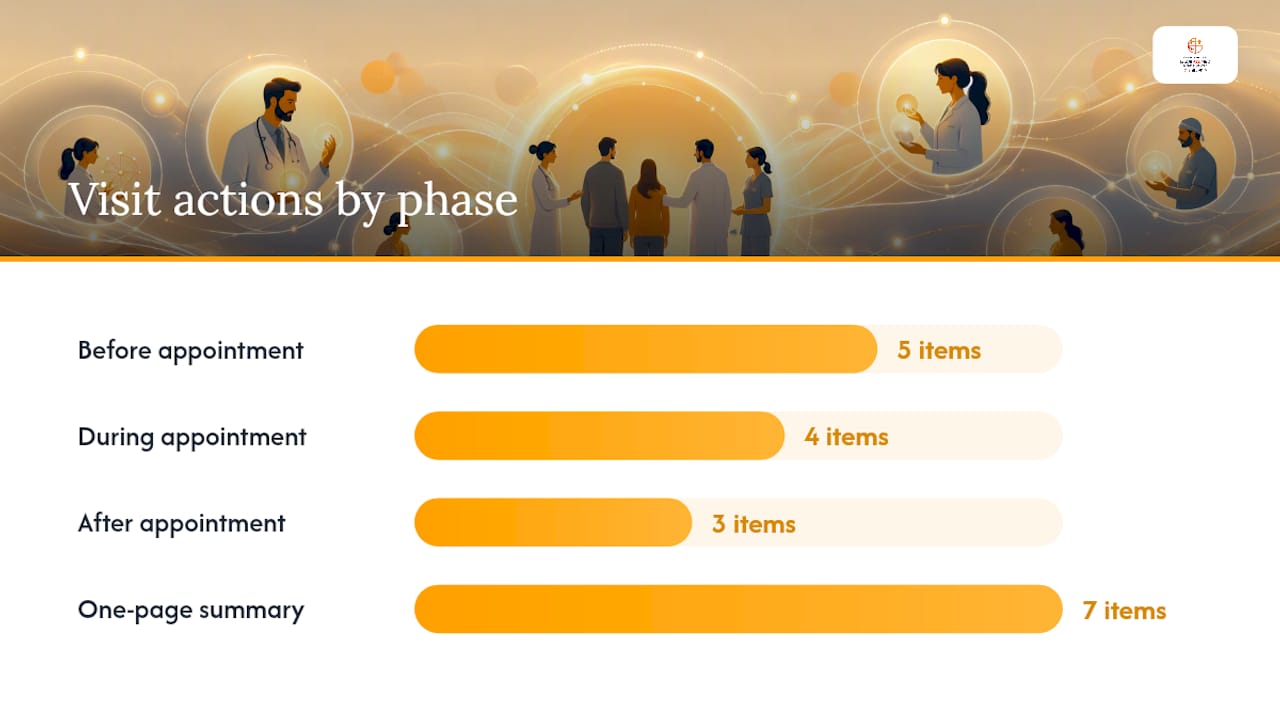
A structured before-during-after sequence is the most reliable way to reduce fragmentation in multispecialty healthcare. The specialist consultation preparation checklist covers the full documentation format; the sequence below gives you the time-bound framework.
Before the appointment:
- Gather all recent lab results, imaging reports, and specialist notes from the past 12 months
- Update your medication list (name, dose, frequency, prescribing provider)
- Write a two-line visit goal: what you want the specialist to address and what decision you need made today
- Confirm that your records have been sent to this specialist from your PCP and other relevant providers
- Sign or renew any records-release consent forms needed for cross-provider sharing
During the appointment:
- Hand the specialist your one-page medical summary and medication list at the start of the visit
- Ask: “Are any of my current treatments from other providers a concern for what you’re managing?”
- Ask: “Will you send a note to my PCP after today’s visit?”
- Confirm the next step in writing: who orders the next test, who reviews results, and when
After the appointment:
- Request a copy of the visit note before you leave or through the patient portal within 48 hours
- Update your personal medical summary with any new diagnoses, medication changes, or procedures discussed
- Schedule the follow-up appointment before leaving the office
One-page medical summary fields to include:
- Full name, date of birth, and emergency contact
- Active diagnoses (with date of diagnosis)
- Current medications (name, dose, frequency, prescribing provider)
- Known allergies and reactions
- Recent procedures and key test dates (last HbA1c, last imaging, etc.)
- Current specialists and their contact numbers
- Insurance information and PCP name
Sample appointment question script:
“I’m seeing several specialists right now. Before we finish today, can you confirm: will your notes go to Dr. [PCP name]? And is there anything in my current medication list that concerns you given what you’re treating?”
How medical teams share information and what you should ask about
The technical channels your care team uses to share information matter more than most patients realize. Knowing which systems are in place, and whether your providers actually use them together, tells you where the gaps are likely to appear.
Electronic Health Record (EHR) portals are the most common tool. Platforms like Epic MyChart or Cerner’s patient portal let you view notes, lab results, and medication lists. The catch: not every specialist uses the same EHR, so “shared records” often means a provider can request records, not that they receive them automatically.
Health Information Exchanges (HIEs) connect different EHR systems across hospitals, clinics, and specialists in a region. When your providers participate in the same HIE, an alert can go to your PCP and specialist simultaneously after an emergency department visit or hospital admission. CMS models specifically highlight this kind of provider alerting as a key mechanism for improving transitions of care.
Secure messaging through a patient portal is useful for non-urgent coordination questions. It creates a written record and is faster than a phone call for straightforward requests like “please send my recent labs to Dr. [name].”
Multidisciplinary team (MDT) meetings or combined clinics bring relevant specialists together, either in person or virtually, to review a single patient’s case. Cross-specialty collaborative care research from BMC Medicine (2025) links these formats to faster decisions and better disease control. For patients with complex conditions, requesting one is worth the ask. Integrated outpatient care models explain how combined clinics work in practice.
Questions to ask your providers about information sharing:
- “Are you on the same EHR system as my other specialists?”
- “Does your practice participate in a regional Health Information Exchange?”
- “Can I give written consent for you to share my records directly with Dr. [name]?”
- “Is there a way to request a brief joint call or virtual MDT review given how many specialists I’m managing?”
Pro Tip: When care is complex, ask your PCP to request a 15-minute virtual case conference with two or three of your specialists. A single joint call can establish that relationship and resolve weeks of back-and-forth.
What to do at key transitions: discharge, surgery, and rehab
Transitions between care settings are where coordination failures concentrate. A hospital discharge without a clear handoff plan is one of the highest-risk moments in multispecialty healthcare.
At hospital discharge, do these before you leave:
- Collect the written discharge summary and confirm you understand every medication change
- Reconcile your medication list: compare what you were taking before admission with what is on the discharge prescription
- Confirm that the hospital has sent your records to your PCP and relevant specialists
- Schedule a follow-up appointment with your PCP within 7 days of discharge
- Ask: “Who do I call if my symptoms worsen before my follow-up?”
CMS care coordination models identify post-discharge provider alerting, where the hospital notifies both the PCP and the specialist after an acute event, as a core mechanism for preventing readmission. If you do not receive a call or portal message from your PCP within 48 hours of discharge, contact the office yourself.
At the first post-discharge visit, confirm:
- Every medication on the discharge list is still appropriate and has been reviewed by your PCP
- Any specialist follow-up appointments are scheduled and the specialist has received the hospital summary
- Lab work or imaging ordered at discharge has been completed or is scheduled
- Your one-page medical summary has been updated to reflect the hospitalization
Statistic callout: Research on care transitions consistently identifies the period immediately after hospital discharge as the window of highest readmission risk. Scheduling a timely PCP visit after discharge is an evidence-backed step a patient can take to reduce readmission risk.
For a detailed timeline of what to confirm at post-discharge visits, the follow-up care best practices guide covers the full sequence.
Common coordination breakdowns and how to fix them
Most coordination failures follow predictable patterns. Recognizing them early gives you a practical path to resolution before they affect your care.
Problem → Solution pairs:
- Missing notes or records: Call the sending practice directly and ask for a fax or secure portal transfer. Give a specific deadline: “I need this by [date] before my appointment.”
- Duplicate tests ordered by two specialists: Tell each provider which tests the other has ordered. Ask: “Can you use the results from Dr. [name]'s recent order instead of repeating this?”
- Conflicting medication recommendations: Do not start a new medication until your PCP or pharmacist has reviewed the full list. Say: “I want to confirm this is safe given what Dr. [other specialist] prescribed before I fill it.”
- Slow referrals: Ask your PCP’s office to send a warm referral, meaning a direct call or message to the specialist’s office, rather than a standard referral letter.
Sample script for requesting a joint review:
“I’m managing care with Dr. [A] and Dr. [B], and I’ve received recommendations that seem to conflict. Would it be possible for you to speak with Dr. [other provider] directly before my next visit so we can align on a plan?”
Red flags that require urgent escalation:
- A new medication causes an immediate adverse reaction
- Two specialists have given you directly contradictory instructions about a treatment
- You are discharged from the hospital without a follow-up appointment scheduled
- A specialist has not received your records after two documented requests
- Your symptoms are worsening and no provider has responded within 24 hours
If any of these apply, contact your PCP’s office the same day and state that you need urgent coordination support.
How insurance and Medicare affect care coordination services
Understanding what your plan covers for coordination services can unlock real support, particularly for patients managing multiple chronic conditions.
Medicare offers programs that may reimburse coordination activities for eligible patients, including Chronic Care Management, Transitional Care Management, and Principal Care Management.
- Chronic Care Management (CCM): For patients with two or more chronic conditions, CCM covers at least 20 minutes per month of care coordination services, including medication management and care planning.
- Transitional Care Management (TCM): Covers coordination support in the 30 days following a hospital, skilled nursing facility, or inpatient rehabilitation discharge.
- Principal Care Management (PCM): Covers coordination for patients with a single high-risk condition requiring intensive management.
Medicare’s care coordination programs create a reimbursed pathway for patients to receive structured support for medication reconciliation, care planning, and specialist communication. Patients who qualify and do not ask about these programs often leave real support on the table.
Questions to ask your insurer or Medicare plan:
- “Am I eligible for Chronic Care Management or Transitional Care Management services?”
- “Does my plan cover telehealth visits for multidisciplinary case reviews?”
- “Is a care manager or case manager available to me under my current plan?”
- “Does my plan require prior authorization for specialist referrals, and who manages that process?”
If a coordination service is denied:
- Ask for the denial in writing with the specific reason
- Request that your provider document medical necessity in the appeal letter
- Ask your provider’s billing office to submit a peer-to-peer review request
- Contact your plan’s member services and ask for case manager involvement
Commercial plans vary widely, but most cover some form of case management for complex conditions. Healthcare.gov’s plan comparison tools can help you identify what coordination benefits a plan includes before enrollment.
When to ask for a formal care manager or MDT review
Some coordination needs exceed what a patient can manage alone. Knowing when to ask for formal support, and how to ask for it, is one of the most practical skills in effective patient management.
Request a formal care manager or MDT review when:
- You are seeing two or more specialists with conflicting treatment plans
- You take five or more medications daily, particularly across multiple prescribers
- You have been hospitalized or visited the emergency department more than once in the past six months
- Your symptoms are worsening despite following the current treatment plan
- You or your caregiver feel unable to track all the moving parts of your care
Script to request a care manager from your PCP:
“I’m currently managing care with [number] specialists, and I’m concerned that important information is falling through the cracks. Would it be possible to assign a care manager or case manager to help coordinate my care? I’d also like to know if a multidisciplinary review of my case is appropriate.”
What to expect from a formal care manager:
- An initial assessment of all active conditions, medications, and current providers
- A written care plan summarizing goals, responsibilities, and timelines
- Regular check-in calls or visits to monitor symptoms and follow-up completion
- Direct communication with your specialists on your behalf when needed
- Assistance with scheduling, referrals, and insurance authorization
PMC research on specialty care coordination confirms that structured care coordinator roles and formal agreements between providers close the gaps that patients and clinicians both report experiencing in informal coordination arrangements.
Patient toolkit: templates and scripts you can use right now
The tools below are designed to be printed or saved on your phone before your next appointment. The common specialist consultation questions list provides additional question templates organized by specialty.
Medical summary template (one page):
- Patient name, date of birth, blood type, and emergency contact
- Active diagnoses (condition name, date diagnosed, managing specialist)
- Current medications (name, dose, frequency, prescribing provider)
- Allergies and documented reactions
- Recent procedures (procedure name, date, performing provider)
- Key test dates (last HbA1c, last colonoscopy, last imaging with result summary)
- Current specialist roster (name, specialty, phone number)
- Insurance: plan name, member ID, PCP name and contact
Medication list template:
- Medication name (generic and brand)
- Dose and frequency
- Prescribing provider
- Condition it treats
- Start date
- Any known interactions or warnings noted by a provider
Appointment agenda for a multispecialty visit:
- State your two-line visit goal at the start
- Hand over your medical summary and medication list
- Ask the specialist to confirm receipt of your PCP’s referral notes
- Work through your prepared questions (use the consultation questions list above)
- Confirm next steps in writing before leaving
Sample portal message to request clinician-to-clinician communication:
“Dear Dr. [name], I am currently under the care of Dr. [other specialist] for [condition]. I would appreciate it if you could send your visit notes from today’s appointment directly to Dr. [PCP name] at [practice name]. I have signed a records release for this purpose. Thank you.”
Pro Tip: A one-page medical summary carried by the patient is one of the highest-yield tools clinicians report for preventing duplicate tests and medication errors during multispecialty care. Update it after every appointment and keep a printed copy in your wallet or bag.
GLOBALLMED Medical Center supports integrated multispecialty care
For patients navigating care across multiple specialists, the practical challenge is finding a setting where coordination is built into the structure, not left to chance. GLOBALLMED Medical Center, Macau’s largest private outpatient clinic, brings general practice, surgery, OB/GYN, ENT, dental, urology, pediatrics, dermatology, physiotherapy, and more under one roof, with a clinical team designed to work across specialties rather than in isolation.

Patients who book through GLOBALLMED Medical Center can access multiple specialties in a single visit, with direct communication between providers built into the process. International patients and medical tourists benefit from multilingual support, insurance direct billing, and a dedicated international patient coordination team. The center’s outpatient medical services cover the full range of conditions that typically require multispecialty management, from chronic disease to post-surgical follow-up.
To book a coordinated consultation or speak with the patient support team about scheduling across specialties, visit GLOBALLMED Medical Center and use the online appointment booking form. The team can help you schedule multiple specialists in sequence, reducing the coordination burden you would otherwise carry alone.
This article is general information, not a substitute for advice from a qualified doctor. Consult a qualified healthcare professional about your own circumstances before acting on anything here.